Friday, June 18, 2010

Syria: clothing and other incidentals

Clothing...it's complicated. And in Syria, street fashion is complicated and convoluted.
Twenty years ago, 70% of women did not "cover"; now it is just the opposite. Ten percent of the population is Christian, so they don't cover. Of the women who cover, there are different levels of covering: head scarf (hijab)and regular clothing or medium length/long trench coat, fully cloaked with head scarf, fully cloaked with face veiled (niqab). Women not fully robed wear a variety of current fashions (jeans, stilettos, crop tops over t-shirts (many with sayings in English and/or "engrish" that are very suggestive), skirts to knees. What they wear under the trench coats or cloaks is hard to know. But, on younger women, the trench coats are very tight fitting, leaving little to the imagination. The decisions made by women on what to wear, do not seem to be religious in nature, which is what makes it complicated. Some decisions are based on fashion, family pressure, the desire by women to find husbands: men tend to marry late because they have to buy a house before marriage; they marry younger women because they want children and then want their wives scarved to show unavailability to other males.

Men's attire is much like anywhere, except for those in robes and/or wearing head scarves. Young men are in jeans and t-shirts with slogans and sayings most in "engrish": there must be some factory in China that sends all its seconds and misspelled logos to Syria! Shoe fashions for hip males tends towards the looong toe, squared off at the tip.
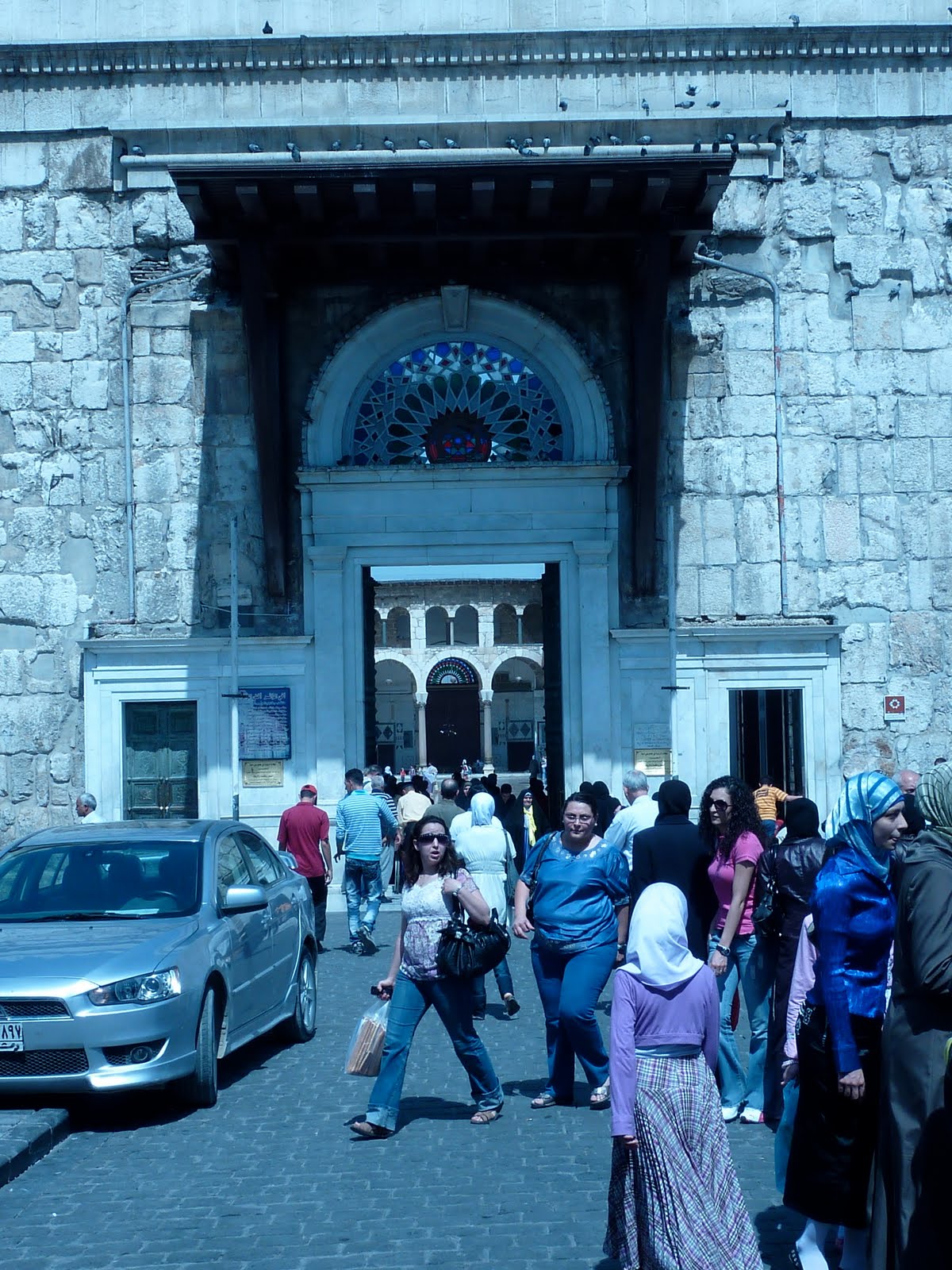
Below are some crowd photos taken around shops in the souks, people milling, shopping, etc.

Trench coats in a shop in the Damascus souk:
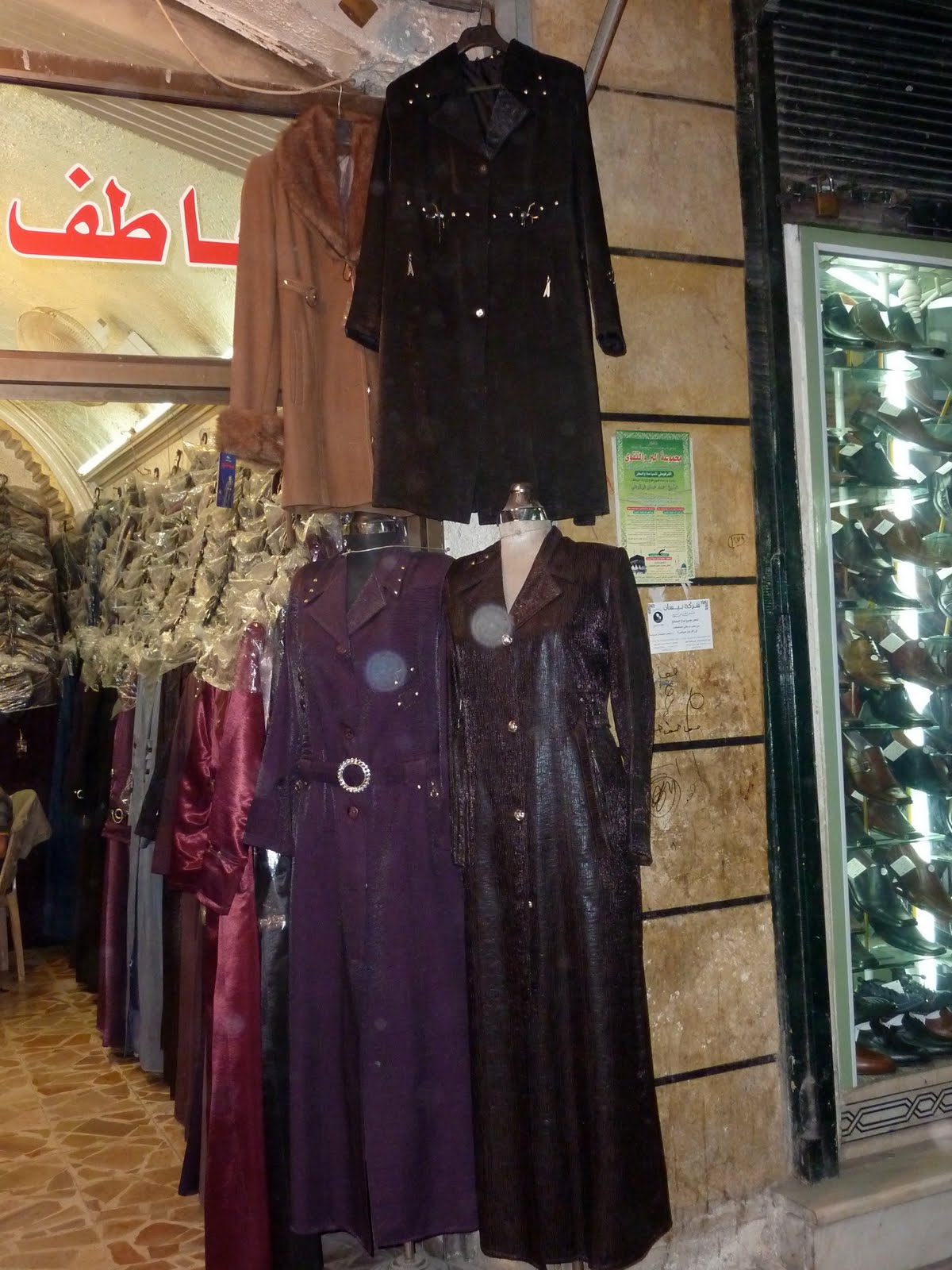


What to wear under the trench coats.......


Diorama in the Azm Palace, Hama: fashion in the 1750's:


We had to rent cloaks to enter the Umayyad Mosque, Damascus:


Many fashion statements in the souk, Homs:


Locals outside the Umayyad Mosque:

Jewelry Row in the souk, Damascus:


Locals between the souk and mosque, Damascus:


Back courtyard of the Umayyad Mosque outside Saladin's tomb:


Tourists are advised to dress modestly and neatly: no knees (as in shorts or short skirts), no sleeveless tops (even if you look great in them). But, there are always those (especially if they travel in large groups and so are somewhat distant from the locals), who choose otherwise.

Tuesday, June 15, 2010

Syria: Illegal vehicles & plastic chairs

After leaving Damascus and heading north from Hama into the countryside, we began noticing very interesting looking trucks, usually with 'Hyundai' on the back, but nothing like any Hyundai we had ever seen. These were customized beyond recognition. In fact, we were to learn from one of the drivers we had hired, that they are custom built in Syria and totally illegal: not registered, not licensed: people just pay the fines if stopped by police. Some had hummer fronts; side panels that looked like, and every bit as beautiful as, Ndebele art motifs. The interiors were also customized with a highly developed sense of aesthetics. We learned that these cars are manufactured in Halfawiyah and have very powerful engines, usually Mercedes, and used mostly for trucking agricultural products or other raw materials. Here is a video of these


Other ubiquitous items included plastic chairs: every merchant in the souks sat on them, non-fancy restaurants, outdoor cafes. My favourite use of them was as carpet pegs: people hung their oriental rugs over balconies to air them out, holding them in place with several plastic chairs. Dark green seemed to be the most common colour, but we saw them in purple, white, brown.

Syria: comparative architecture

Traveling through Syria, I was continually reminded that not only is this a very ancient land, but it really has been witness to everything, in terms of human behaviour and invention, and that it has been the playground and battleground of people from virtually all over the planet.

Driving through a sandstorm from Resafa to Palmyra, we saw beehive houses. These houses are mud-built and whitewashed and cool in summer and insulated against freezing winter nights. Few of these houses are left, as they have been replaced by grey concrete blocks...far less attractive and effective. Beehive houses are also seen in Turkey, Italy (where they are called trullis), South Africa (called rondavels), Ireland, and Scotland. See the photos below. The first two photos are near Palmyra, the next in Transkei, South Africa, and the last in Alberobello, Italy.


Friday, June 11, 2010

Syria: Food

We ate delicious, fresh, well prepared food. Fresh fruits, whether made into fabulous juice drinks or offered at the end of most meals in Damascus, were abundant.

Fruit and vegetable market in Homs
The owner of the Noria Hotel in Hama advised us to stay away from parsley and mint as they frequently carry ecoli. Since parsley is in tabouli (delicious) and mint in refreshing lemonade drinks, this proved difficult.

Dinner at Layali Salihiyya, Damascus.

On only two occasions, in Homs, did we eat non-Middle Eastern food, both Italian. The first,at the Safir Hotel (not our style), was not memorable and the hotel was filled with busloads of various Europeans. The restaurant itself was located around a pool with palms overhead, bougainvillea in abundance, and lots of local businessmen. The other Italian meal in Homs, at Matrix, was excellent: food, people watching (the bags! the shoes! Sex and the City Redux!), ambiance.

In Aleppo (see descriptions/list in the Lonely Planet), as in any city of three + million people, there are restaurants at every social and price point. Even the most expensive meals we had were very cheap. We ate at Cordoba (in upscale neighbourhood), Beit Sissi (beautiful old home in Jdaideh, aka the Christian Quarter) , Al Qommeh (upstairs on fifth floor, mostly locals, live oud). One of the delights of dining in Syria arrives in the English spellings on the menus given to tourists. Fortunately, our son could read the Arabic. Eggplant is usually referred to by its French name 'aubergine', and one of our favourite menu items was 'stuffed aborigines'...this kept us going for days. Also on the menu were 'lamp chips' (lamb chops).

According to the prophet, one's fast is always broken by eating seven dates to keep ones system operating properly. After that, breakfast usually consisted of olives (black and green), hummus, yogurt (dry and wet), flat bread and often croissants and/or rolls, several types of cheese, hard boiled eggs (sometimes also beautifully thin omlettes) fruit, juices, tea, and both Syrian coffee and Nescafe.
Here is breakfast at the Talisman Hotel:


Alcohol is served in very few restaurants and then all that is found is Syrian wine (terrible) and Lebanese wine (OK) and various beers from Egypt, Europe, Russia. Beer, wine, and spirits can be purchased in the Christian Quarters of cities, a few non-Christian neighbourhoods in the larger cities. Most restaurants serve fruit-based drinks, tea, and coffee. The juice bars in all cities make fabulous fresh squeezed fruit drinks and smoothies (banana and milk based).

And desserts! Ice cream!
Here is the packed ice cream parlour in the souk in Damascus:

Monday, June 7, 2010

Syria: Impressions upon arrival and buildings

Arriving in Damascus at midnight: an assault on the senses even in the dead of night. The traffic, the people, the buildings. The first two days were overwhelming: I wondered how we would survive crossing six lanes of traffic on foot with bicycles weaving in and out (often against the flow), services (micro buses, pronounced 'serveeces'), taxis, trucks, all honking to let each other know their intentions, needs, locations: no lane markers, traffic cops sitting and preening in their motorcycle mirrors, and everyone nudging their way around. After a few days, this seemed just so normal! and logical! All components of the traffic system were much more tolerant of each other's needs (want to turn left from the far right lane, four lanes over? no problem!).

People stay up very late at night, including children, to and fro a great deal during the day (high unemployment and underemployment assures lots of street life), smoke cigarettes continuously, stop at the juice bar, buy snacks (lots of junk food) at the corner store or in the souk, sweep continuously and still there is tons of garbage.

Seventy percent of the women cover their sin (head hair!), a direct opposite of the percentage twenty years ago. Ten percent of the population is Christian. Most women do not cover their faces. Head-scarved women can be found wearing a variety of fashions on the street: full-length trench coats (in 100 degree weather!), so thin in fabric, so tightly fitted, that not much is left to the imagination on body shape/size (photos to come in future entries). Or, they can be wearing the latest in tightest jeans with layered, fitted tops, stiletto gladiator sandals. And the underwear on display in the lingerie shops in the souk! Young men wear the latest in graphic t-shirts with amazing spelling errors: must be the seconds from factories in China...if they knew what their chests were saying!). But, more on people later.

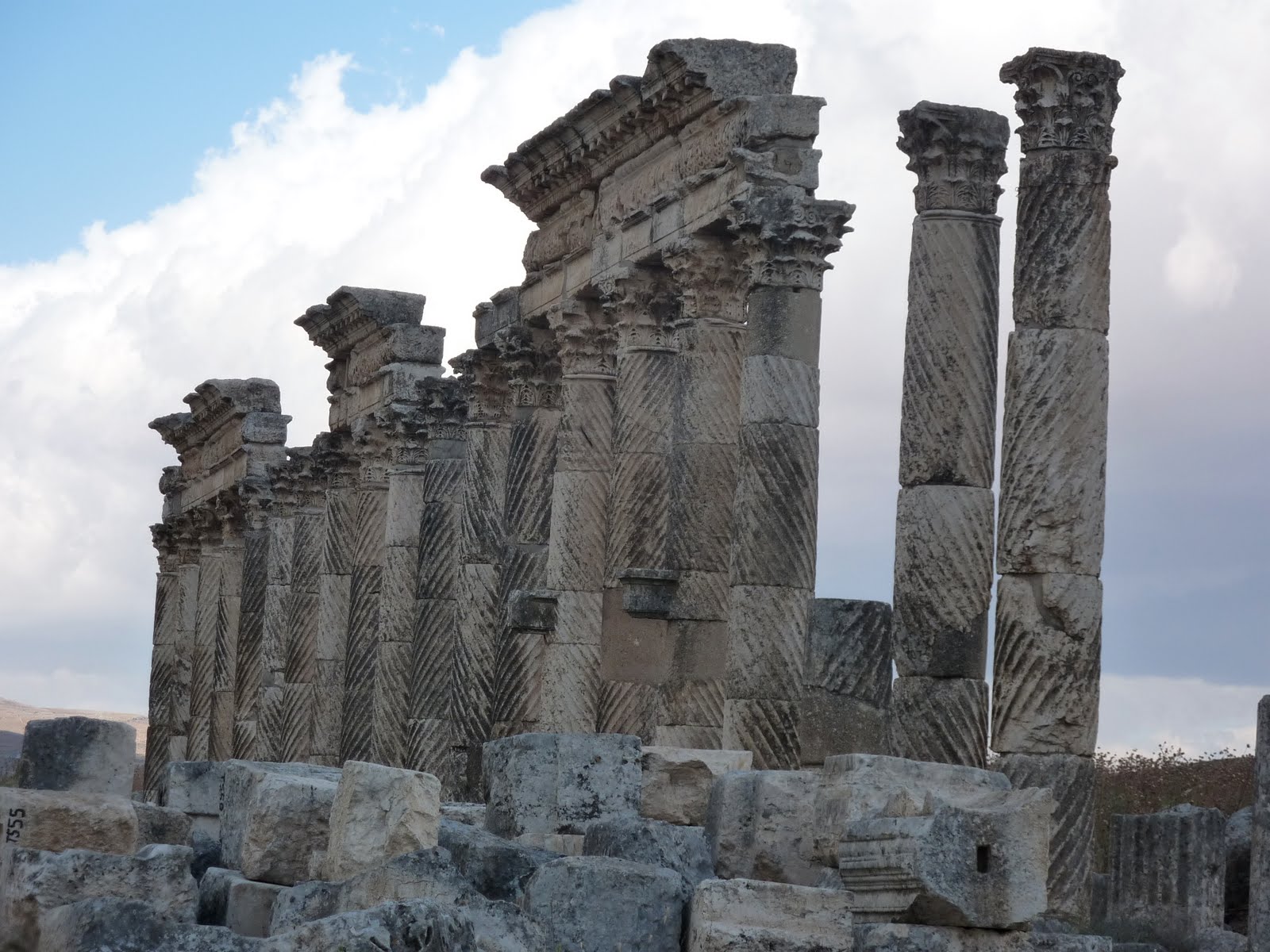
The buildings. My husband described Syria as a multi-millennial construction site. There are ancient ruins upon even more ancient ruins. There are modern ruins. There are buildings left in a state of semi completion because if it not finished, you don't have to pay taxes. There are commercial buildings abandoned. And because most homes face their interiors (even if the owners are not wealthy enough to have an interior garden/courtyard), the streets look even gloomier. The goal of most people under the age of 60 is to leave Syria and the buildings give that sense of being on the verge of being abandoned if not already in that state. Here are some photos of various kinds of buildings:


St. George's Monastery nr Krak de Chevalier


Serjilla, one of the Dead Cities

New bldg nr Krak de Chevalier

Grand Mosque Aleppo


Courtyard Talisman Hotel Damascus


Bedouin tents below Marqab Castle


Azm Palace Damascus

Apamea, UNESCO World Heritage Site


40 yr old unfinished embarrassment in Damascus (this building is such a sore point for the dictatorship, that you have to be very careful taking it's picture!)

Saturday, June 5, 2010

Back from Syria

Over the next few days I will be writing about our 2.5 week trip to Syria. This is one interesting, but schizophrenic, society!

Saturday, May 8, 2010

Ach Shame, Another Warrior Dies

Sheena Duncan, a leader of The Black Sash, has died. A small number of the least likely warriors, middle class white South African women, took up civilian, non-violent action against the inhuman machine of the Apartheid Regime in South Africa. These women (as mentioned in my post of 3 Jan 2009 in memory of my mother, Shirley Singer), stood vigil demonstrating against the pass laws requiring non-whites to carry their identification papers with them at all times (gee, sound familiar?), against "forced removals, detention without trial, inequality and repression. Then, at last, the transforming years of the 1990s brought the organisation back to constitutional issues once more, celebrating the prospect of a Bill of Rights and arguing for the right to administrative justice to be included" (see the link to Black Sash history above). These women refused to bow to the authorities, stood still while being pelted with rotten tomatoes by unsympathetic whites, and used their position of white-skin-privilege to campaign for the rights of their fellow countrymen and women.

Friday, May 7, 2010

The Land of Green Plums The Land of Green Plums by Herta Müller


My rating: 5 of 5 stars
Herta Muller won the Nobel Prize a couple of years ago. She writes about a particular group: German speakers living in Romania. This particular book is about the rise of totalitarianism and the subversion of humanity under Ceausescu. It is a very painful read and a look at a particular group that has not had much attention paid to it outside of a small set of borders. The situation of these German-speaking Romanians has interesting parallels with ethnic Germans in Ukraine who no longer speak German but "feel" German; Russians who had been exported to the Baltic nations during the Soviet era.
A good book/play to read in conjunction with this is Mad Forest by Carol Churchill, which looks at the unraveling of the Ceausescu regime and how that affected people's personal relationships, language, and thinking abilities.

Friday, April 30, 2010

Painful and beautiful

The Surrendered The Surrendered by Chang-rae Lee


My rating: 5 of 5 stars
Such a finely drawn, beautifully written (except for some weird typos and a surprising number of times the word 'array' or 'arrayed' was used), painful, and so sad book. There characters had so many burdens, beauty was seen but rarely experienced, always off stage.

Thursday, April 29, 2010

Endangered Languages

Very interesting article in today's NYT on efforts in New York to record, possibly save, but most certainly appreciate endangered languages that are hanging on by the skin of their teeth in New York. It is a loss to the richness of our collective human cultures when we lose languages and knowledge through attrition and inattention.

Tuesday, April 27, 2010

In the last weekend's FT, Gideon Rachman reviews 'The Beijing Consensus: How China’s Authoritarian Model will Dominate the Twenty-First Century' by Stefan Halper. Rachman is generally favourable in his review, but where he raises issues and questions makes for interesting and thought provoking reading. Halper comments on why China has been successful in Africa and why many in Africa welcome China over the west. Rachman finds some of Halper's thesis a bit overbearing and ponderous and suggests that it would be more useful to consider "how big emerging powers such as Brazil, India, Indonesia and South Africa position themselves, as the US and China struggle to mould the international agenda."

For more on China in Africa, see NYT article on Niger.

Friday, April 23, 2010

Bait and Switch

Another World Cup cop-out and bait-and-switch, this time in South Africa.....reminds me of the Chinese in Africa...who can out-hoodwink who the fastest. For more commentary, see London Review of Books Vol. 31 No. 24 · 17 December 2009.

Thursday, April 22, 2010

A travel memory

This item in the Financial Times of London on visiting Lecce, Italy, brought back such vivid and pleasant memories of my visit there in 1969. I was the guest of a family and we traveled by ferry from Bar, in the former Jugoslavia to Bari in Italy, and then down the coast to Taranto and Lecce and then to Alberobello...those trulli were awe-inspiring and stirred the imagination of a very romantic teenager!

Monday, April 19, 2010

Disturbing and Depressing

Two items, one from last month and one last weekend, are of concern to anyone with a moral compass. A story in this last weekend's NYT about the South African Jewish community threatening Judge Goldstone with physical and mental anguish if he attends his grandson's Bar Mitzvah in Johannesburg because they don't like his judgment regarding the government/military of Israel's behaviour in Gaza. Shame on them for their thoughtless knee-jerk response.

And, in last month's London Review of Books, read Yonatan Mendel's explanation of "Hasbara": preemptive messaging and spin control. The left wing secularists in Israel have a lot of work to do!

China and Venezuela

China needs oil, Venezuela needs money and a friend: a match made by Mephistopheles!

Saturday, April 17, 2010

The Help The Help by Kathryn Stockett


My rating: 5 of 5 stars
I had not expected to like this book and began it with some trepidation, thinking it might be another of those self-congratulatory I'm-not-one of-those.... In fact, I thought it was excellent! Well written, it mad me sad, angry, anxiety-filled as the story moved into the frightening territory of "laws of the South" being broken. It is hard to remind oneself that 1963, and the particular indignities of the South, was not that long ago.

Friday, April 9, 2010

If you need to get lost for a while....

Let the Great World Spin Let the Great World Spin by Colum McCann


My rating: 5 of 5 stars
Not only is the writing, the language, the evocations exquisite, but the story, told from several points of view, is a page turner. McCann's ability to get inside the heads of his characters is uncanny.

Those early humans just keep popping up!


The New York Times reported on yet another interesting find of early humans...this time in South Africa. These fossils were found in 2008. In addition to the two individuals mentioned in this article, another story mentioned the finding of a female and a young male, there was an additional female and an infant, along with numerous types of animals.

Tuesday, April 6, 2010

Fluttering

Yesterday, a wintry, windy day outside as I sat in a room full ebullient people doing good. In a moment of quiet, the inside air still, a little flutter and tug at my heart. A Tinkerbell of a moment, a hesitation. Ah yes, a little mind/heart visit with Ariel.

Tuesday, March 30, 2010

Two stories caught my attention last week: The first was on PRI's The World about the government of Iceland banning strip clubs in an attempt to combat trafficking in women. Over the last several years, over 1000 women have been brought into Iceland (pop. 300,000) for the sole purpose of being put to work in the sex entertainment industry. Studies in other Scandinavian countries have found that for vulnerable women, there is a very short leap from strip clubs to prostitution. Check out the comments on the website to gain insight into opinions and thought(?) processes of some of the yahoos who listened to the show. One of the themes running through Stieg Larsson's trilogy (The Girl with the Dragon Tattoo, The Girl Who Played with Fire, and The Girl Who Kicked the Hornets Nest)is trafficking in women and the horrors associated with this human rights abuse situation.

The second real life human horror story concerns the war on innocents in Congo being conducted by the Lord's Resistance Army. Jacob Acaye, a young man who had been captured at age 11 by this group and was able to escape after three weeks, was in Seattle last week talking about this in conjunction with the Peter Eichstadt, author of "First Kill Your Family". They were guests on KUOW's show Weekday.
There have been a number of documentaries made on various aspects of this crisis, especially about the child soldiers. Also check out the website of War Child International.

Wednesday, March 24, 2010

Early humans popping up everywhere!

A story in Scientific American about DNA analysis of a finger bone found in Siberia, indicates that this may be a previously unknown early human who is not us!

Friday, March 19, 2010

3 by Dove at PNB

Two reviews of last night's opening of PNB's current rep, one in The Seattle Times and the other in Spokane's examiner.com can only hint at how fabulous the whole evening was. The photographs by Angela Sterling accompanying the reviews attest to the incredible gift she has for capturing the essence of every dancer's body, soul, and professionalism. As wonderful as her photos are, they are no substitute for actually being there! Make every effort to get there and tell your friends!

Cape Cosmos

A while ago (1 February 2010), I wrote about a radio program I heard on KUOW about Race and the Space Race. The producer of the show, Richard Paul, just sent me the link to the new website that contains this story. It is well worth taking the time to find out more about black pioneers in space

Thursday, March 18, 2010

Monday, March 15, 2010

Nelspruit and Athol Fugard

This last weekend, the New York Times reported on two South African-based issues: one depressing ,one uplifting (isn't that always the case with South Africa?). Let's start with the uplifting story first, shall we? Athol Fugard, the playwright who has been campaigning against apartheid all his life, has a new play currently being staged in a remarkable venue which is now home to a new all black company housed in the new theatre, bearing Fugard's name, located in District 6, site of one of apartheid's most shameful deeds.. The play deals with post-apartheid white shame and guilt.

The second story is about the shame, corruption, violent, and disgraceful behaviour of politicians and bureaucrats in Nelspruit, in their pursuit of fame and fortune in the wake of the World Cup, at the expense of children and vulnerable adults. Only four games will be played in the stadium and for this, two schools were bulldozed, nearby people live in mud huts with no "amenities"......water, electricity, roads. And who will be able to afford to attend these games? Only the local wealthy and foreigners.

Wednesday, March 10, 2010

A little too much edge.....

Too Much Happiness: Stories Too Much Happiness: Stories by Alice Munro


My rating: 3 of 5 stars
I am a real Alice Munro fan. This group of stories I found as disturbing as her stories usually are, as well written as usual, but somehow, not as satisfying. The last story in particular, which lends it's title to the collection, was very much not in keeping with her other works. In most of her stories, all is not as it appears when the stories set out; the little twists and turns are often innocuous seeming but take on a edge that can disarm and disturb. This collection seems more that way than previous collections.

View all my reviews >>

Wednesday, March 3, 2010

Horrific, just horrific

A story on the BBC World service tonight about the birth defects in Fallujah was just horrific. It seems that rubble from the bombing and fighting has been bulldozed into the river and contaminated the drinking water. The descriptions of the conditions of these children is heart breaking....

Sunday, February 28, 2010

China and Africa

This article was sent to me by my son, Graham, knowing my interest in the role the Chinese have been playing in African economic investment and development for a number of years now. The Economist online magazine runs a monthly debate topic, complete with pro and con sides and a moderator; readers are allowed to weigh in on the debate and vote for the side of their preference. A recent topic was the same as that discussed in the article above: is China good for Africa and why are people making disparaging remarks. I have discussed this in previous posts particularly in light of the fact that Africans from many nations are complaining about the Chinese role in their economies...this is not just jealous/zealous Westerners being concerned.

Friday, February 26, 2010

In need of a good read at a galloping pace? Get this book!

Half Broke Horses Half Broke Horses by Jeannette Walls


My rating: 5 of 5 stars
What a great read! A story told in the first person about growing up in the west...it would make Wallace Stegner proud.

View all my reviews >>

Wednesday, February 24, 2010

Fabulous Finds

Having been out of the internet loop, due to software issues, for almost a week thta has had so much news, has been difficult. First, an article in the NYT on a recent find that very early humans occupied Crete is just amazing. These early ancestors had to travel in a systematised way over water and they created these incredibly beautiful tools: For more information, check out the June issue of HESPERIA.

Next of interest was an article, also in the NYT, on the legacy of apartheid and public transportation and urban planning issues.

And finally, a public radio report on history, history books, and brainwashing featuring South Africa, the former Eastern Europe, and a third country. I heard the promo for it on KUOW, but no amount of searching could get me to the link..let me know if any of you find it!

Friday, February 12, 2010

What a disappointment

Brick Lane: A Novel Brick Lane: A Novel by Monica Ali


My rating: 2 of 5 stars
This book had it moments of lovely language and thoughtful insights. But, I could hardly wait to finish it, as it was driving me crazy.

Sunday, February 7, 2010

Precious, the Oscars, thoughts

I have not see the film Precious. I have seen trailers, read reviews, listened to people talking about their reactions after seeing the film. The people whose opinions I have received and whose conversations I have been part of have not been unanimous in their responses, they have been black, white Asian. They have all agreed that it was a difficult movie to watch, largely for the child abuse that is a large part of the film. Last Friday, the NYT op-ed page contained a commentary by Ishmael Reed. A similar response was elicited (in the African American male population) after The Color Purple was made into a film. I get what Reed is saying. It is not a question of a right or wrong opinion to have in this regard and certainly, where you stand is where you sit. But how close a reflection of reality is Reed's view of reality?

Monday, February 1, 2010

Race and NASA

Mae Jemison, the first African-American female astronaut, hosted an hour-long program exploring the role NASA played in integrating employment in the south (Florida, Alabama, and Texas), and creating opportunities for blacks in highly specialised fields. NASA was not without it's own issues regarding race and that was discussed in the program as well. But, listening to the now-retired engineers and scientists about how they got involved in NASA, about growing up and being educated in the south, etc was fascinating.

Monday, January 25, 2010

Flowers in the Desert


Just looking at this photograph is enough to send the mind into paroxysms of delight. The botanical gardens of the Huntington Library in Pasadena are very special, especially the cactus groves. Robin Lane Fox explored the gardens recently.

Immigrants & Migrants

A very important op-ed piece appeared in today's NYT. It concerns African immigrant workers in Italy. I have previously posted about the treatment of various minority populations in European countries and the resurgence of nationalism and fear of the "other". This op-ed piece by Roberto Saviano peels back another layer of the problem: the mafia. Saviano points out that native-born Italian workers are too afraid to stand up to the mafia,m who control the economic sectors in which the immigrant/migrant workers were protesting bad working conditions. Just like here in the US where no one wants to do the very hard work done by migrant workers from south of the border, so too in Italy: farm labour, menial labour, construction labour. Yet resentment about the presence of these people festers and all the negative "isms" emerge. Migrant workers face these issues all over the world: China, Middle East. For more information, check out the website of the Migration Policy Institute.

Tuesday, January 19, 2010

Regarding the grass is always greener........

There was an op-ed piece in today's NYT on an aspect of people's skin-tone issues: it is called 'colorism'! This is a problem all over the world and nothing new.

The grass is always greener........

An article in the NYT on 15 January got me thinking about how odd/funny us humans can be. The story was in the health section on the use of skin lightening creams by darker skinned people and how many of these creams are prescription strength but often purchased without one. These creams are also sold in many immigrant grocery stores and come from unregulated sources. These creams can cause cancer and have other serious side effects. While many people use these creams topically to lighten age spots or other dark spots, many others use them on large areas of their faces and bodies because they want a lighter skin tone. This got me thinking about the tanning industry. In spite of tanning bed companies saying these things are safe, will not cause cancer, etc there are studies showing otherwise. And people still spend money at tanning salons, roast themselves on beaches and at poolsides, and apply creams to tan themselves chemically. So, on the one hand, we have darker toned folks lightening themselves, and on the other hand, paler folks darkening themselves.......

Saturday, January 16, 2010

Rory Stewart

Read this linked piece written by Rory Stewart who is a candidate for the Conservative Party in the Cumbria district. He is an experienced and thoughtful observer of people, politics, and history. He wrote The Places In Between (about walking across Afghanistan in the footsteps of Alexander) and Prince of the Marshes (about Iraq and reconstruction). I find it interesting that he has taken this road in his local politics. It reminds me a bit of Michael Ignatieff whose biography of Isaiah Berlin was outstanding. He also wrote Blood and Belonging, about the new, rising nationalisms around the world: it was excellent and thought-provoking.

Read about Haiti's Slave Uprising

Writer & professor, Madison Smartt Bell, wrote a trilogy about Haiti: All Souls' Rising, Master of the Crossroads, and The Stone That the Builder Refused; as well as Toussaint Louverture, A Biography. Read these to get a sense of the travesty foisted upon these people and the Medea-monster that grew out of infighting amongst the the various French factions, the racial hierarchy that was created, and the how the seeds for Haiti's troubles were sown way back in the 1700's, only to be compounded by US meddling in the 19th and 20th centuries.

Monday, January 4, 2010

Aaah, so satisfying!

Once I realised that I could order volume three of Stieg Larsson's fabulous series from amazon.uk (the US edition will not be published until May...what were they thinking when they thought they had to "build interest"??), I got my order in ASAP. Read the book in three days. Apparently, there is part of a fourth manuscript left....let's hope Larsson's lifelong companion prevails in the face of his greedy father and brother and is allowed to administer his literary estate. To think that, even in Sweden, a couple not legally married at time of death has the same issues facing us here...

The Girl Who Kicked the Hornet's Nest (Millenium, #3) The Girl Who Kicked the Hornet's Nest by Stieg Larsson

Thursday, December 31, 2009

Summing up

Well, it seems to be the thing to do. I have procrastinated posting recently because the story I wanted to highlight just seemed to be too depressing. There was an article in the New York Times a week ago on violence in Polokwane, South Africans against Zimbabwean and other African refugees. It is depressing to me because it speaks to the inability of the South African government to fully address the needs of its own people. It is depressing because the problem that is Robert Mugabe is still there, making life miserable for the people of Zimbabwe. It is depressing because the "lost generation", primarily men 24-50 whose education was interrupted due to school boycotts beginning in the mid-1970's in protest against the Apartheid regimes 'Bantu Education' policies, will never gain full employment and may only ever settle for under-or-unemployment. And it is depressing because it is a microcosm of all societies where inequity breeds discontent, distrust, and violence.

On a more upbeat note, I saw Invictus last night. Now, I know and can appreciate the complaints by South Africans that no South African actors played the lead roles. But in reality, this was a movie made for a non-South African audience and is another Clint Eastwood exploration of revenge/redemption stories. He usually focuses on the revenge of the underdog and the making of this movie is about the ultimate revenge of Nelson Mandela. I found many parts of the movie very moving for the feelings they invoked about the man Mandela. It reinforced in me the sense that Nelson Mandela is, and will be, regarded as one of the most amazing and important human beings, ever.

Tuesday, December 22, 2009

Consistent Behaviour.....and all of it negative

The Chinese are nothing if not consistent: their actions in Africa have been mentioned here before. They offer investment in economic development in developing countries: infrastructure development, resource extraction, etc The expectation is that this will lead to much needed employment growth, ancillary business growth,etc. Various African nations which have negotiated such deals with the Chinese have found that it is an all-inclusive package: the Chinese bring with all their own workers, restaurateurs, equipment. And now the Vietnamese are complaining! And the Indians! Check out the NYT article linked here.

And shame on the Cambodians for sending back the 20 Uighers who had fled repression in China and now face certain imprisonment and torture. And how remarkable that this was done one day before the arrival of the Chinese who, the day after their arrival in Phnom Penh announced an economic development package worth $1 billion! Are the Cambodians expecting the Chinese to also employ locals, patronise local restaurants, buy goods form local businesses?.....see above for frustrated expectations elsewhere. And where are all those newly found human rights principles that were rediscovered since the fall of the Khmer Rouge? Shame on them all.

Monday, December 21, 2009

And Give More....

Nicholas Kristof wrote and article in the NYT on 16 December about the school that Valentino Deng and Dave Eggers are building in Southern Sudan, in the town that Deng grew up in before it was burned to the ground and he became on of the Lost Boys of Sudan. Dave Eggers wrote What is the What: The Autobiography of Valentino Achak Deng, based on conversations he had with Deng and all the proceeds from the book went to starting this school project. Buy the book, read about Deng's Foundation in the links, send money.

Sunday, December 20, 2009

This Holiday Season, Give through KIVA

I have found great satisfaction making loans to and sharing the lives of people vetted by KIVA.

Thursday, December 10, 2009

Romania's Securitate Legacy

Two references to Romania's past have appeared recently. A BBC report by Oana Lungescu describes files kept on her own family, as well as others, that have become available for perusal. And today, Herta Mueller, a German citizen born & raised in Romania (part of the German minority there), who fled in 1982, was awarded her Noel prize for Literature. The German minority in Romania was also in the news this past week, when the NYT reported on the popular mayor of Sibiu. Such interesting stories.....

Friday, December 4, 2009

The Salt Trade

A story on the BBC about profound, and permanent, changes in the salt trade in Mali, reminded me of other aspects of this story I heard about a number of years ago that have immense implications for all humans in terms of our repository of knowledge accumulated over our species' time on earth. The BBC story reported on how the use of trucks, instead of camels, to haul salt from the mines to market (such as Timbuktu) has impacted the lives of the Tuaregs. A truck journey to-and-from the mines is a week; a camel journey is 45 days. Tuareg customs dictated that when a person had made three round trip journeys by camel to haul salt, he was ready for marriage: the trip by truck does not prove perseverance, responsibility, any accumulation of knowledge. Another story also focused on how climate change has made the journey with camels very difficult because of the lack of water at needed intervals for the camels.


The story I heard about a few years ago, concerned how the fact that the Sahara Desert was traveled by fewer and fewer people working in the salt mines, resulted in the loss of knowledge of how to read the desert. Reading the desert by the Tuaregs or Bedouin is like reading the snow by the Inuit and Eskimos. This knowledge about our environment is dying out...using a GPS device is just not the same. Having the information in text books only is not the same. While no one would wish the traditional life of a salt miner/trader on anyone, it is also a shame that we will eventually lose information on reading/understanding/living in an environment that taxes all of our creativity, acuity, and endurance.

Monday, November 30, 2009

Stalinism, Russia, & Chechnya

The London Review of Books, 19 Nov 2009 issue, contains an article of interest to those concerned about the psychopath and his master who are ruining lives in Chechnya and a commentary for those interested in the convoluted/tortuous mind-bending to-ing & fro-ing that takes place amongst the politicians and the peoples of the former Communist Eastern block countries.

Jonathan Littell writes about the horrors being committed in Chechnya in his article Chechnya, Year III. What he comes to realise is the the new "normal" resembles the worst of the Stalinist years when people kept their heads down, their noses to the grindstone, saw 'progress' and 'prosperity' around them....as long as they asked no questions.

Slavoj Zizek, in the same issue, leads us down the contorted pathways of post Communist elections. And if you add into that mix the ideas of the expats of these countries, you start getting dizzy.

Anyone interested in the communication/philosophical/mind games issues resulting in the fall of an Eastern Block country should read Caryl Churchill's play Mad Forest: A Play from Romania...she does a great job illuminating the problems.

Saturday, November 28, 2009

The Northern Clemency The Northern Clemency by Philip Hensher


My rating: 5 of 5 stars
I began this book with a little trepidation as it seemed that the psychological edginess might going where I wasn't sure I wished to go. However, that was not the case and I thoroughly enjoyed finding out how the members of these two families grew and changed during the book's long time-frame. There was a great deal of humour and knowing about British politics and social issues makes the book much richer than if the reader is unfamiliar with same.

Wednesday, November 18, 2009

Your REI, Eddie Bauer, or North Face will just not make it at the opera.....

Designers transform the puffa
By Alex Gorton in the FT's Weekend edition


Puffa jackets

Autumn/winter puffa jackets by, from left, Giles Deacon, Iceberg, F by Fay and Junya Watanabe

"As winter looms, complete with icy winds and freezing body parts, the question of coats becomes as pressing as what to wear to the office Christmas party. How do you look good while also maintaining your core body temperature? The two requirements do not necessarily go together, sartorially speaking." To read more, click on the story headline above.....

How American Health Care Killed My Father - The Atlantic (September 2009)

How American Health Care Killed My Father - The Atlantic (September 2009)

Tuesday, November 17, 2009

Racism, Communism, Nationalism

President Obama's visit to China has highlighted, as usual, the many inequities and iniquities of life under the Han. Coverage this week on PRI's The World and the Seattle Times underscore, yet again, the sad state of affairs regarding the views of the Han people towards people of darker skin colour. Various apologists said that the lashing out at the young biracial (black Chinese) woman on the Chinese TV show was just due to ignorance...listen to/read the comments: I think not.

The increasing number of Africans moving to China for economic reasons (the influx of Chinese investments in various countries in Africa) has lead to an increasing number of cases of harassment against these people. During the heyday of Chinese and Soviet jockeying for spheres of influence in the developing world, they encouraged African students to travel to China and the Soviet Union for training. Even then, being black in those parts of the world was not easy. But in the name of comradeship and worker solidarity, overt racist behaviour was suppressed. With the rise of the ultra right nationalists in Russia and China flexing it's geo-political muscle, and with both countries trying to control minority populations within and around their borders, racism is rearing it's ugly head even higher.

Monday, November 9, 2009

The Chinese in Africa, again

The Seattle Times carried an article on China's investments in Africa. I cannot paraphrase...it really must be read to be believed. Just look at who thinks Chinese investments are great: Mugabe, Bashir, and China's lame apology regarding investing in treacherous, repressive regimes...

Wine, Food, Fun

October and November are busy months in Washington State as winemakers get their grapes in before the frost and start on another adventure in creating fabulous wines. There are a fair number of winemakers who live in the Seattle area and make wine out of "garages". I decided to volunteer my labour helping winemaker Tim Narby of :Nota Bene in return for learning about the process of making wine. I got really good at deck swabbing, washing buckets with antimicrobial solution, labeling barrels. Here I am in action filling the press with grape skins to squeeze out the last of the juice.

For my work, I was paid in delicious blends and Syrahs....aaaah, what a life.

This last weekend was the annual Cayuse barrel release weekend in Walla Walla. Eastern Washington was aglow in autumnal tones, the cloudscapes were a wonder, and the warm welcomes at the wineries was a pleasure. We visited Cayuse (it's 13th birthday!), Sapolil, Adamant, Buty, K Vintners, Forgeron. We ate a fabulous dinner at Whitehouse-Crawford and ran into our favourite sommelier, Robert, formerly of 26 brix. We had our first meal at Saffron Mediterranean Kitchen, a wonderful addition to Walla Walla's culinary scene: Chris and Island Ainsworth are fabulous chefs, hosts, and humans! The interior of the restaurant has subtle Ottoman touches: Turkish screens, Moroccan lights, warm tones, nothing overdone. The menu is interesting and well executed.

Tuesday, November 3, 2009

Two Disturbing News Reports

A report on NPR news this morning about increasing enforcement in Chechnya of strict Islamic laws in daily life is a chilling reminder of what can happen when a people have been tormented, repressed, subjugated, and then brought back into the fold with bribes and a wink. The Russians must be worrying about the monster they have created in their midst in an attempt to keep their territorial integrity intact in the face of losing many of their former "stans", rather than think about what might have been good for the Chechens.

The second horror story of the day was heard on KUOW: Rana Husseini was interviewed by Steve Sher about her new book "Murder in the Name of Honor: The True Story of One Woman's Heroic Fight Against an Unbelievable Crime." There is almost no country in the world where women are not killed by male members of their families if the family believes it's honour has been tainted by the behavior of a female relative. Honor killings have happened in Britain, Italy, USA, countries in South America, the Middle East, Africa. Shame on the perpetrators, the legal systems where the killers are exonerated, the social mores and norms that deem what the neighbours think more important than the life of a woman. Shame on us all.

Friday, October 23, 2009

Horsey's editorial cartoon says it all


Washington State has been beset by a plague called Tim Eyman. He has submitted initiatives to our ballot boxes that sound too good to be true and the cost to our state in terms of services that the community needs and enjoys has been overwhelmingly awful. Even Joni Balter, of the increasingly conservative Seattle Times, has tried to educate voters about the consequences of this plague.

Wednesday, October 21, 2009

Wow, China on my radar twice in one week!

More news on China's outreach to the developing world. I have before mentioned China's role in infrastructure investment/development in Africa and the consequent frustrations by the various African nations because China does not employ locals in these projects. This morning, NPR had a story on Chinese investment in.....Afghanistan! One of the key insights in this story was that because these investments are made by the Chinese government, not private companies, money is no object, so that competitive bidding just does not happen and firms from other countries do not have a chance. China wants access to Afghanistan's natural resources and wants to ensure delivery. They made the proposal to do these projects on the grounds of helping redevelop Afghanistan in the wake of war. They support NATO efforts and cause, but do not wish to commit military money or equipment. This seems admirable on the surface, except that they are not actually helping rebuild what the Afghans need. And as paranoid as China is about the Uighurs and other minorities, they are perfectly happy for other nations to deal with Islamist-based terrorism.

Monday, October 19, 2009

Two of my favourite topics

Monday's NYT had stories on two of my favourite topics/rants: China and its attempts to expand its sphere of influence and South Africa and its cartoonish incarnations of political leaders.

China was the honoured guest at the Frankfurt Book Fair and naturally, they attempted to control which authors could attend, which books to promote, etc and complained that members of the Dalai Lama's entourage might be there. They seem not to get it that most of the world has no desire to play by their rules or to squash individual freedom.

And the farce that is currently on display in a corruption trial in South Africa requires a playwright to reveal that truth is far stranger, and more entertaining, than fiction.

Speaking of South Africa, the 8 October 2009 edition of the London Review of Books has a very interesting review of RW Johnson's new book "South Africa’s Brave New World: The Beloved Country since the End of Apartheid". Roger Southall's review is thought-provoking.

Can't wait for book three!

The Girl Who Played with Fire (Millennium, #2) The Girl Who Played with Fire by Stieg Larsson


My rating: 5 of 5 stars
What a page turner! The pacing was relentless, there were surprises, what a great read!

Tuesday, October 13, 2009

When no new news is still news....

The weird tale of the hijacked Russian ship last summer continues to wend its murky way through the news machines without getting any clearer. A report in Sunday's New York Times contains the priceless comment by the ship's second in command: “Something certainly happened out there, but we are not allowed to talk about it"....! Where are the hijackers? Who really are they? What is their fate? Why is the ship now have a North Korean name painted on it? What will be the fate of the remaining three crew members still on board?

Tuesday, October 6, 2009

Hilary Mantel Wins!


Hilary Mantel wins Booker for Wolf Hall! She is just a fabulous writer, researcher, thinker.