Monday, October 11, 2010

Yakima Valley Wine Country

Washington State is the home of over 650 wineries,  eleven AVA's or designated appellations, and 350 grape growers.  The Yakima Valley was the first federally recognised AVA.  The Yakima Valley is also home to the Yakama Nation.  This last weekend, I accompanied the wine maker/owner of :Nota Bene to the Yakima Valley to pick up bins filled with grapes-just-picked and drop off bins for grapes-to-be-picked and also for bins ready for next year.  We drove 700 miles, fourteen hours, six vineyards, and brought back 12 bins of beautiful grapes (this was trip three for wine maker Tim Narby; three left to go!).  The vineyards we visited were: Stone Tree Vineyards, Stillwater Vineyards, Ciel du Cheval, Champoux, Dineen Family Vineyards, and Red Willow Vineyards.
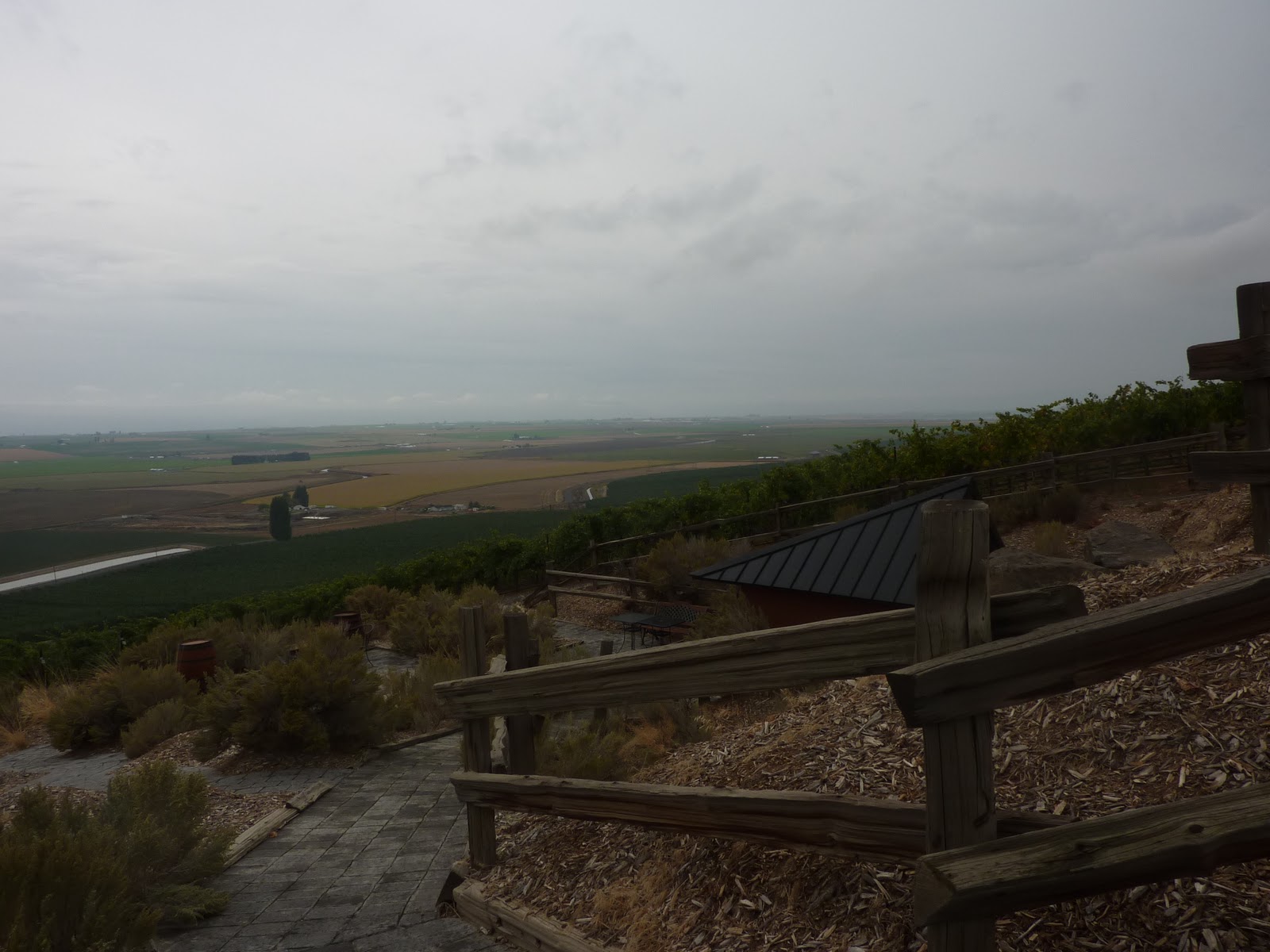
                                         View from Stillwater picnic area

                                  Champoux Vineyard:  netting to keep birds away

                                          Ciel du Cheval, stop # 3, loading the grapes

Boxes ready for filling.  Champoux Vineyards

Tuesday, October 5, 2010

A True Hero: A Man Who Died in the Cause of Seeking Truth & Information

On 18 September 2010 I posted a link on Facebook about a story NPR ran about Witold Pilecki, a Polish Army Captain:  "In September 1940, Pilecki didn't know exactly what was going on in Auschwitz, but he knew someone had to find out. He would spend two and a half years in the prison camp, smuggling out word of the methods of execution and interrogation. He would eventually escape and author the first intelligence report on the camp."  He sent this information to Churchill and Roosevelt and the Polish Army in exile tried every means at its disposal to tell the world about the Holocaust.  Take time to learn about this man.

Monday, October 4, 2010

The Roma, again

PRI's The World reported on efforts to reintegrate the Roma into Bulgarian society.  This link should get to an audio of the report.  The question remains/arises:  what is  it about Europe (east or west) or elsewhere that the Roma  create this tension and inability for one group to be accepted by another.  This situation has been intractable for over 1000 years. A second Wikipedia link has some interesting information on the arrival of Roma people in North America in the early 19th century.

Saturday, September 25, 2010

Zuma heading south?

The Economist blog features this article re: Zuma being sidelined. Seems to me, the only way forward for South African politics is that COSATU and the ANC  separate and that other parties begin to fill the void.  The coziness of the two powerhouses, especially given the organizational/power structure of the ANC, equals corruption and stagnation for South Africa. The ANC Youth League seems to have been chastised for 'behavioural' issues.  For more of Zapiro's political cartoons and commentary, see this link.

Tuesday, September 21, 2010

Cross Dressing, Gender Roles, Social Needs

In June 2008, the New York Times carried a fascinating story about women in Albania who live their lives as men, largely because their families had lost viable males in honour killings, war, etc.  This practice is, apparently dying out. Today the NYT has a story about girls in Afghanistan who are dressed as boys. Many of these girls are loathe to return to female roles/clothes because of the constraint this places on their lives. Be sure to read the comments (click on the 'Highlights' tabs of the comments section): some people are shocked, amazed, puzzled, intrigued, etc.  The particularities of situations like this vary, but there have certainly been examples of women dressing as men (in life and fiction), men dressing as women, in all cultures through many ages.

Tuesday, September 14, 2010

The ANC Continues to Accumulate Demerits....

In Sunday's New York Times, Andre Brink contributed an op-ed piece on the "cloud of secrecy" beginning to shroud the dissemination of untainted information in South Africa.  In Tuesday's Mail & Guardian there is a report on a conference in Cape Town on this very cloud of secrecy. The shudders are starting to ripple.....when will the tide turn against the rot in the ANC....

A rightful slap on the wrist....

The EU has finely had enough and found it's spine: 
European Commissioner Vice President and Commissioner for Justice Viviane Reding scolded the French for hiding their true intention of getting rid of the Roma, despite protests that these eviction notices pertained to all illegal immigrants, etc, etc, etc.

Monday, September 13, 2010

Another fine intellect departs.....

I was traveling and out of the news-loop (learning about horse racing instead) and so just today learned about the death of Frank Kermode on 17 August 2010.  His wisdom and insights will be missed.

Tuesday, September 7, 2010

The Booker Shortlist is Announced

The six shortlisted authors are:
Peter Carey, Emma Donoghue, Damon Galgut, Howard Jacobson, Andrea Levy and Tom McCarthy.
I am sorry that David Mitchell was not amongst the above.  Damon Galgut is my favourite: his earlier work, The Impostor, is very thought-provoking, on a personal and political level.

Monday, September 6, 2010

The Thousand Autumns of Jacob De Zoet: A NovelThe Thousand Autumns of Jacob De Zoet: A Novel by David Mitchell

My rating: 5 of 5 stars


This is the kind of book I want to race through to see how it ends, but the language is so beautiful, the observations so acute, the texture so deep, that restraint is required.  And, the book doesn't just end...there are endings, and twists, and turnings, all the way through.  A brilliant writer, interesting topic.

Saturday, September 4, 2010

Now it's the Italians, again, dumping the Roma....

Today's New York Times features the Italians vs. Roma. Following the lead of the French, the Italian authorities are closing legal encampment sites..in some cases, Roma families have been living, and making a living, here for several decades.  The situation of the Roma in all of Europe is untenable and seems intractable.  For  personal views by an outsiders, read Bury Me Standing by Isabel Fonseca and Zoli by Colum McCann

Tuesday, August 31, 2010

At least there are some in France who have a conscience

Members of the French public and a number of politicians have spoken out against Sarkozy's Roma expulsion mania.  Today's Financial Times provides details.  A search of the FT's site finds 79 articles on the issue of Roma in France.  Peruse them to get a sense of the problems faced by these people everywhere.

Monday, August 30, 2010

Saturday, August 28, 2010

The Plight, and Forced Flight, of the Roma

So, the Roma are once again on the run.  This time it is the French who are kicking them about and kicking them out.  According to the New York Times, "On instructions from President Nicolas Sarkozy, the French police have been dismantling improvised Roma camps in recent weeks and deporting Roma groups to Bulgaria and Romania."  Bulgaria and Romania?  And how are the Roma treated there?: As reported in WAZ.euobserver.com: "The Romanian society sees the gypsies as a foreign element", said Claudiu Padurean, a journalist and executive director for the Human Rights League in Cluj, a Transylvanian city with a large gypsy population. "Their degree of integration into the society is very much reduced. One can only imagine what the general reaction would have been if the expelled people were ethnic Romanians, and not Rromas", Mr Padurean said."  As for the Bulgarians, perhaps their attitude is somewhat better than that of the Romanians

France is not alone:  Denmark began expulsions a few weeks ago, as well.

Thursday, August 26, 2010

Horse Racing: stepping into a new universe

The universe in which horse racing exists is complex and requires that the novice learn a whole new vocabulary (do you know what a 'spinner' is? a 'stooper'?) including how to read the racing forms, how to bet, amongst other things, and calibrating a whole set of social strata.  There is the horse, the event, the aftermath.  The horse= owner (individual and/or syndicates) + trainer + groom(s) + jockey + food + housing + veterinarian + accoutrement + fees (for events, licenses, etc) = money.  The racing = venue, fees/licenses, vendors (restaurants, food, booze, souvenirs, linens, toilet paper, office supplies, cash machines, computers, etc), employees (management, event development/planning, janitorial, cashiers, judges, track maintenance, food service workers, supervisors, grounds maintenance, meeter/greeters, announcers, judges, IT), equipment (large and small, complicated and simple), racing forms,  TV monitors, camera operators/photographers, and associations for all of the above.  None of this would exist if it were not for the spectators, bettors, entourages.  These all form the pageant.  This requires a variety of fashion statements.

Friday, August 13, 2010

Basil Davidson Died Last Month

Basil  Davidson was a path-breaking journalist and historian of Africa and Yugoslavia.  He was 95.  He called fascists to task.  He called imperialists and the settler class to task.  He did not shy from confrontation and lived a life of conviction and integrity. There are two tributes to him in the London Review of Books.  And perhaps one of the highest compliments paid to him is found at allafrica.com in piece by Cameron Duodu.

Thursday, August 12, 2010

Those early humans are at it again...

makes me think of Dad....on what would have been his 86th birthday.....

Story in today's NYT on Lucy's ancestors as tool makers

The Daily Mess

This morning, Steve Inskeep, on NPR's Morning Edition, interviewed Tom Ricks about his prognosis for Iraq: it is cause for pause when someone is more hopeful about the future of Afghanistan (this link takes you to BBC stories) than Iraq!  Tom Ricks' book "Fiasco" is a must-read for anyone seeking a well-written and researched account of this misguided adventure.  Ricks also has a blog that is useful to check on.  Ricks is also a contributor to Foreign Policy.

Monday, August 2, 2010

Grim News

Venezuela is killing off union activists who disagree with Chavez.  Saudi Arabia and UAE plan to ban Blackberry use because they cannot break through its encryption software to spy on users.  Domestic workers are abused, physically and emotionally, in Kuwait. Stoning of women continues in Iran (and, Brazil offers to be an intermediary!).  Palestinians continue to live in limbo and their Arab neighbours do not really care.  Journalists and lawyers continue disappearing in China.  The US continues its great wall policy on the US-Mexico border.  US right wingnuts continue to insist that gun-toters in parks are just exercising their rights, even as two people get killed at a suburban Seattle lake-side park.  And then there is Sudan, Congo, Tibet, the Stans, Russia.

I think I'll look for the good news tomorrow.

Thursday, July 29, 2010

Gorillaz in Damascus....

Gorillaz performed live at the Citadel in Damascus on 27 July, with the Syrian National Symphony Orchestra...that must have been some concert!  You can listen to it here, from NPR.

Sunday, July 25, 2010

Back to old issues: China and Africa

For China watchers, there was an interesting letter in London Review of Books vol 32 No 12 from Hugh Miles in response to an article by Adam Shatz about the decline of Egypt under Hosni Mubarak.  The letter writer points out that while Shatz focuses on the relationship between Egypt and the US and Israel, another relationship has been developing:  the influence of China.

Here is the letter in full:
"Seventeen thousand Chinese are now officially resident in Egypt and the volume of trade between the two countries has gone from $635 million in 1999 to more than $5.86 billion in 2009. Besides granite and marble, China imports Egyptian cotton, oil, carpets and kitchen sinks. English is the main language of business, but around the Free Trade Zones, cheap manufacturing bases close to European markets with very few export restrictions, most of the road signs are in Chinese. According to Egypt’s General Authority for Investment, there are 1038 Chinese companies operating in Egypt, representing a total investment of $311 million.
‘Before the Chinese arrived everyone was leaving this neighbourhood,’ I was told recently by an estate agent in the Cairo suburb of New Maadi. ‘Nowadays you see more Chinese round here than Egyptians. They’re here for this.’ He tapped the granite counter. ‘After the first wave came all kinds of small businesses to service the community, like gyms, restaurants and shops. Then a second wave came to work for Huawei when it replaced Siemens and Alcatel as Etisalat’s main contractor in Egypt.’ Huawei Technologies is the second largest telecoms company in the world. Last November Wen Jiabao opened its $20 million new training centre in Cairo’s Smart Village. ‘We have a business relationship,’ the estate agent said. ‘They don’t care for football or religion. All they think about is business, except when they are drinking tea and playing cards. But there are no problems and we say hello to one another when we pass each other in the street.’
The Chinese Embassy has gone on a charm offensive of film festivals, photo exhibitions and, last February in Rihab City on Cairo’s eastern outskirts, a cultural week showcasing martial arts, Chinese music and tea art. Two Confucius institutes have been established and last year China Central Television launched a new Arabic-language satellite TV channel.
The love-in appears to be reciprocal. From 1999 to 2009 Egypt’s exports to China grew from $15 million to $989 million, creating thousands of new jobs. In the last six years, five Egyptian universities have opened Chinese departments and Chinese goods are a familiar part of everyday life. A new character has made an appearance in Egyptian soap operas: the Arabic-speaking Chinese saleswoman going from door to door, offering cheap consumer goods, bootleg DVDs and snappy haircuts. Egyptians joke about the quality of the imports and grumble that the Chinese never spend any money. Their fathers used to grumble about the Soviets for the same reason.
China’s relationship with the Arabs dates back to the Silk Road, but modern relations can be traced to 30 May 1956 when Nasser defied the US policy of containment to become the first Arab or African country to establish diplomatic ties with the Communist state. (Later that year Chinese newspapers celebrated the nationalisation of the Suez Canal.) Mubarak himself has been to China at least seven times. In 1999 he signed a key strategic agreement in Beijing and since then co-operation has deepened to include infrastructure building, training, energy and defence. There are goodwill politburo visits every few months and at the start of May Egypt’s Oil Ministry signed a memorandum of understanding with China National Petroleum Corp to build Egypt’s biggest ever oil refinery in a contract worth $2 billion. ‘Things are going perfectly,’ according to Zhijie Zeng, the director of the China Development Bank. ‘We are eager to deepen the co-operation. Africa and China have a win-win relationship.’
But the press has spoken of China’s ‘commercial attack’ on Egypt, and there have been accusations of Chinese products being dumped in Egypt at below cost price. In January a Chinese ship accidentally destroyed coral reefs in South Sinai. And in the second half of last year China abruptly halted trade shipments to Egypt. The official reason was to combat smuggling but the move sent the price of some commodities shooting up 40 per cent."
Hugh Miles
Cairo

Just makes one think.....
Wednesday, July 21, 2010

Lights and lighting in Syria

Armenian Church, Aleppo

One of the delights of touring the souks, citadels, churches, hotels, and other buildings, was the lighting.  At times, there was the feeling of being in an Ottoman fairytale.  CFL bulbs are used everywhere and while that seems so environmentally with-it, garbage disposal is such a nightmare in Syria, one really wonders where the used bulbs end up.

Below are some examples of such interest and beauty.


Reception Room, Citadel, Aleppo
Umayyad mosque, Damascus
Lights, Marian Church, Homs

Talisman Hotel, Damascus, divan room

Souk, Aleppo
Divan room, Talisman Hotel, Damascus

Ceiling of bath house, Citadel, Aleppo. Alabaster inserts

Lights in mosque, Hama

Bedroom, Talisman Hotel, Damascus
Courtyard, Casa Mia restaurant & boutique hotel, Palmyra

Fruit & vegetable market at 11pm, Aleppo


Lights in the Armenian Church, Aleppo.  Note Mamaluk-style arch

Maybe the niqab will fall by the wayside......

On 19 July, NPR reported that the Syrian government had banned the niqab in universities and on 20 July they reported, in the full education system. Only thing is, it was not announced in the media.

Monday, July 12, 2010

Arches: architectural & engineering things of beauty

Wandering among the ruins and the cities of Syria, I was constantly reminded of just what amazing structures we humans have built. Whether buildings had been erected in Roman, Byzantine, Umayyad, Ottoman, or any other times before, during, and after (such as the Dead Cities), often all that remains of a structure are its arches . They have withstood earthquakes, wind, dust storms, neglect.
Below are photographs taken all through our trip of arches in mosques, churches, Roman temples, monasteries, other public and private buildings, walls, gates, aqueducts.

Bab Sharqi, Damascus


The Citadel, Aleppo


Roman columns & arches on the grounds of the Umayyad Mosque, Damascus


The baths, Apamea; those holes were where the water pipes came in


Old City, Hama


Grand Mosque, Damascus


Monastery courtyard, Krak de Chevalier


Khan off the Souk. Damascus


Inside St. George's Monastery


The Inn at Serjilla


The wine & olive presses, Serjilla


Church, Dead City of Serjilla


Remains of two story house, Dead City of Serjilla


Chapel ,Krak de Chevalier


Baalbek, Lebanon


Courtyard in a khan, Alepppo


Ressafa in a sand storm


Inside Ressafa


St. Simeon


At St. Simeon, north of Aleppo


Colonnade at Palmyra


The three arches, Palmyra

Friday, July 9, 2010

Searching for baskets in Syria

I am a devotee of baskets and basket makers. All cultures through time have made baskets, for utilitarian and decorative purposes. While designs and techniques may vary, there are an amazing number of similarities between cultures and geographic regions.

The first basket-sighting in Syria was made by my son at the ticket office at the entry to the Azm Palace in Hama. The man in the ticket booth indicated that these were very old baskets (there was one large, flat basket and one bowl-shaped one) and that there was a shop in Hama where we could find them....unfortunately, it was closed the day we went looking (most museums and other cultural attractions are closed on Tuesdays).

The next place we saw them was in Palmyra/Tadmor at the Traditional Palmyra Restaurant. The restaurant owner offered to take me to his cousin's shop the next day...we went to the ruins instead. Next stop, Damascus, at the government-certified craft market, the Tekke Sulimaniyah. The baskets there were very garish in colour and did not look as well-made as the older ones. At the Azm Palace in Damascus, one of the rooms displaying works by artisans in the Ottoman era, there was the most fabulous collection of baskets!...obviously, not for sale. It almost seemed that every effort I made to acquire a basket was being foiled, as I found none before we had to leave. Not one to be deterred from getting hold of a basket, a solution was found: my son and his girlfriend were going to be heading to Hama. So, they were dispatched with a mission...find mum a basket. They returned to the artists' quarter in the Old City in Hama and very late in the day found the basket shop. They were told the basket seller would be able to get there by 11 pm! So, they sat around, drank tea (a common experience with merchants and artists), and brought home three lovely old baskets for me. I found an interesting reference to Syrian baskets from 1909..check it out, as there are some great old photos.

Here is a photo of a basket maker:


And here are my three baskets:


Monday, June 21, 2010

Syria: no OSHA (Occupational Safety and Health Administration) here!

Unfinished buildings, abandoned projects, ruins and earthquakes. Those are nothing compared to the daily hazards workers and individuals face on the job and in the home. I won't even go into food handling issues. We saw many, many vehicle repair and illegal assembly "plants": mostly small scale outfits in towns and villages located in "store fronts".....think a small garage for your car at home. No ventilation. No one wearing any protective gear: exposed ears and eyes, often in sandals while wielding welding gear. We saw small construction sites creating new shops ,same thing, no gear, wires and cords everywhere. The wiring in buildings, between buildings, just hanging in and out of windows is enough to give any trained electrician heart failure. It gets cold in the winter and most houses do not have central heating. People use little pot-bellied kerosene heaters, called sobyas, that are hooked up to ducts and pipes as needed and vented to the outside.