There are no words.....
Thursday, June 2, 2011
Tuesday, May 31, 2011
China and Laos
This morning, the BBC news featured a commentary from one of their correspondents reporting from the Laos/China border. One the Chinese side of the border are massive plantations of rubber trees. These trees do not satisfy the needs of China. So, apropos previous blog posts, the Chinese government has been in conversation with Laotian officials. The latter have agreed to supply the Chinese with land to expand their rubber tree plantings. The Laotian government seconded the lands of Laotian villages along the border where farmers owned the land and grew rice. One villager pointed out that the plantations are so vast it will take a million people to work on them.....there are not enough Laotians, he pointed out, so it will have to be Chinese workers.......


Friday, May 27, 2011
The Chinese Behaviour Pattern Continues
They have poisoned their wells with unsafe mining practices. They have ruined villages and wreaked environmental havoc with dam building. They have continued farming and food production with unsafe practices that sicken and kill their own people. And, not content to rob developing countries of their resources, the Chinese are now in need of other sources of food. The have buttered up the regimes of such popular leaders as Lula da Silva of Brazil, getting their foot in the door. And now Brazilians are starting to feel a little uneasy and queasy about the land grab that has ensued as the Chinese are "investing" in small farmers and getting them to grow soybeans. See this story from today's NYT.
To read about their incursions into Africa and the regrets of various African nations, search this blog under 'China".
To read about their incursions into Africa and the regrets of various African nations, search this blog under 'China".
Tuesday, May 24, 2011
Blood Brothers: Putin & Mugabe
Joe Nocera's opinion piece in today's NYT had a great sub-heading: "What Putin & Pals want, Putin & Pals get". This observation is in regard to the trial, and today's conviction, of Mikhail B. Khodorkovsky and Platon L. Lebedev.
Also in today's NYT is a review of Peter Godwin's new book The Fear : Robert Mugabe and the Martyrdom of Zimbabwe. Peter Godwin is a journalist who has two previous memoirs on his life in Zimbabwe: A White Boy in Africa and When a Crocodile Eats the Sun...both excellent. This newest book is another indictment of Mugabe. He really has to go.
Also in today's NYT is a review of Peter Godwin's new book The Fear : Robert Mugabe and the Martyrdom of Zimbabwe. Peter Godwin is a journalist who has two previous memoirs on his life in Zimbabwe: A White Boy in Africa and When a Crocodile Eats the Sun...both excellent. This newest book is another indictment of Mugabe. He really has to go.

Saturday, May 21, 2011
More on South Africa and Libya

www.nytimes.com
South Africa on Friday accused Libyan leaders of spreading “misinformation” about the fate of a South African photojournalist by saying he was alive when they knew him to be dead.
Calcified Mugabe
Robert Mugabe insists that his age is no deterrent to seeking re-election and continued despotic rule in Zimbabwe. Citing his excellent health in the face of claims to the contrary, he says that doctors have told him they are amazed and his good bone structure: perhaps he misinterpreted their diagnosis. He has ruled with such an iron fist that his bones, and brain, must have calcified by now, rendering him incapable of anything but rigid thinking.
Friday, May 20, 2011
Another killing in Libya: South African photographer
The South African official view of Libya:
History of Relations
Unofficial relations between South Africa and the Great People's Socialist Libyan Arab Jamahiriya are of long standing and go back to the days of the struggle against apartheid. The first South African formal accreditation was established on 19 November 1996, when the South African Ambassador to Tunisia presented his credentials to the Secretary of the General People's Committee for Foreign Liaison and International Co-operation (Foreign Minister). Relations between South Africa and Libya are solid and have been highlighted by high profile visits to Libya by both former President Mandela and President Mbeki. South Africa made a significant contribution to negotiations for the release of the two Libyan suspects in the so called "Lockerbie issue".
Maybe the official position will be reassessed and recalibrated affter the coldblooded killing of photographer Anton Hammerl. See this article in the Mail & Guardian.
History of Relations
Unofficial relations between South Africa and the Great People's Socialist Libyan Arab Jamahiriya are of long standing and go back to the days of the struggle against apartheid. The first South African formal accreditation was established on 19 November 1996, when the South African Ambassador to Tunisia presented his credentials to the Secretary of the General People's Committee for Foreign Liaison and International Co-operation (Foreign Minister). Relations between South Africa and Libya are solid and have been highlighted by high profile visits to Libya by both former President Mandela and President Mbeki. South Africa made a significant contribution to negotiations for the release of the two Libyan suspects in the so called "Lockerbie issue".
Maybe the official position will be reassessed and recalibrated affter the coldblooded killing of photographer Anton Hammerl. See this article in the Mail & Guardian.
Tuesday, May 17, 2011
Saturday, May 14, 2011
Accolades for Emma Donoghue
 Room by Emma Donoghue
My rating: 5 of 5 stars
I dreaded starting this book as it sounded just so traumatic and creepy. But, it was a page turner, beautifully written, and well worth putting aside feelings of horror and dismay at the subject matter.
Wednesday, May 11, 2011
Crackdown in Syria
Just a year ago, my husband, son, his girlfriend, and I ate falafel sandwiches near this square in Damascus
.
The above video is from this article from the Los Angeles Times.
You can also find more videos from Syria at this link.
.
The above video is from this article from the Los Angeles Times.
You can also find more videos from Syria at this link.
Tuesday, May 10, 2011
The Pain and Horrors Begat by Apartheid
I listened and sobbed. People are remarkable.
Listen to this show on KUOW:
Forgiving my daughter's killer
Ginn Fourie’s daughter was killed in an attack by the African People’s Liberation Army (APLA) in Cape Town in 1993. After nearly a decade of agonising grief, Ginn eventually met the man who masterminded the shooting, former APLA commander, Letlape Mphahlele. In their own words, they explain how they’ve forgiven each other over the past.
Link - Lyndie Fourie Foundation
Link - The Forgiveness Project
In fact, this whole show on 10 May on KOUW Presents is excellent.
Listen to this show on KUOW:
Forgiving my daughter's killer
Ginn Fourie’s daughter was killed in an attack by the African People’s Liberation Army (APLA) in Cape Town in 1993. After nearly a decade of agonising grief, Ginn eventually met the man who masterminded the shooting, former APLA commander, Letlape Mphahlele. In their own words, they explain how they’ve forgiven each other over the past.
Link - Lyndie Fourie Foundation
Link - The Forgiveness Project
In fact, this whole show on 10 May on KOUW Presents is excellent.
Friday, May 6, 2011
As the sands shift........
Saudi Arabia is taking preemptive action amidst change and unrest in the Middle East. Unsure of its future relationship with the US, it is looking to diversify its supply chain by reaching out to.....China! See/hear this story from NPR. Ah, opportunistic China.
Monday, May 2, 2011
Iran Demands Syria Free Dorothy Parvaz....
Iran has been strangely silent throughout the unrest in Syria. D. Parvaz was born in Iran.....
D. Parvaz is Missing in Syria
Former Seattle Post-Intelligencer reporter is missing. She landed in Damascus last Friday, 29 April, and has not been heard from since. There is a Facebook page dedicated to information on her. A former colleague, Joe Copeland has written a story in the online newspaper, Crosscut. Call the Syrian Embassy in Washington, DC, tweet, and email:


Friday, April 29, 2011
The beginning of the end has begun in Syria

More bloodshed in Dara'a
Crackdown and sanctions
Witness describes crackdown
Iran's hypocrisy and silence
Friday, April 22, 2011
The Horrors & Terror of being a Woman in Pakistan
Pakistan high court frees five accused of retaliation rape
"In a ruling seen as a setback for women's rights in Pakistan, the country's Supreme Court on Thursday freed five men accused of gang-raping a woman on the orders of a village council."
Los Angeles Times

KHALID TANVEER / AP
Mukhtar Mai said she feared the men she accused will seek vengeance against her and her family.
What more can be said about this abomination......
Tuesday, April 19, 2011
Hyperbolic reviews cause subsequent deflation
 The Tiger's Wife by Téa Obreht
My rating: 3 of 5 stars
I enjoyed this book very much, but was disappointed only based on the hype it had received in the literary press. Some of the images are haunting and will stick with me and I thought the idea of the Deathless Man was an interesting device.
Sunday, April 17, 2011
Ronald Singer: In Memoriam, Five Years On
How timely and appropriate. There was an interesting article in The New York Times on Friday 15 April, titled "Phonetic Clues Hint Language is Africa-Born". A biologist from New Zealand has used the model of DNA analysis that has shown the likely spread of humans out of Africa to the rest of the world to look at the origin and dispersal of language in much the same way. What would have pleased my father, Ronald Singer, about this is the showcasing of Southern Africa, a region he researched and felt strongly about: that the most important information about early humans would be found here. Details of his research can be found in this Memoriam written by Paul Dechow. Ronald Singer's last work, on Peers Cave in Fish Hoek, South Africa, is currently being edited by Jay T Stock and Curtis Marean.


Tuesday, April 5, 2011
A glimmer of good news from Lesotho
One dedicated person can make a difference. With some help, she can blaze a trail of good news! An article in Sunday's New York Times profiles Dr.Grace Phiri, a pediatrician committed to saving children in Lesotho from HIV/AIDS. She now has help from several physicians from USA, who, with grant money from the Bill & Melinda Gates Foundation, do good work.
Spring, again

The Mason bees arrive
A gentle nudge, a reminder
Ah, Ariel, a soughing, a sigh.
Thursday, March 31, 2011
Deserts Attract/Encourage Quirky Individuals
A recent trip to Palm Springs, California included excursions to several places that were excellent examples of "only here could this exist"! These were: Cabot Yerxa's Pueblo in Desert Hot Springs and The Edward-Dean Museum in Beaumont. More along the lines of normal were Moorten Botanical Garden in Palm Springs, The Palm Springs Art Museum (especially interesting is an exhibit of architect Donald Wexler's work: he is the father of Palm Springs desert style homes and buildings), and Joshua Tree National Park, where you can see the San Andreas Fault.
 |
| San Andreas Fault |
 |
| Joshua Tree |
 | ||
| Cabot Yerxa's Pueblo |
Tuesday, March 29, 2011
The Hare with Amber Eyes: A Family's Century of Art and Loss
 by Edmund de Waal
My rating: 5 of 5 stars
What a fabulous book! A book about family, history, achievement, accumulation, and loss. It is both personal yet a story to which anyone can relate. It is full of insight, reflects hard work and dedication and how we become obsessed in pursuit of ideas, things, stories, and answers.
Tuesday, March 22, 2011
Thoughtful Pieces of Writing
The eminent thinker and sociologist, Daniel Bell, died in January. Very early on in his intellectual explorations he realised the bankrupt nature of Communism and ideologies in general, yet was able to study and understand the social needs and underpinnings of societies/communities and why they need ideologies. Mark Lilla has written a thoughtful and touching elegy in memory of his mentor in the current issue of The New York Review of Books.
Speaking of ideologies: The online news aggregator, allAfrica.com, reproduced an essay titled 'Manyi and Manuel-Why Apartheid Didn't Die' by Leonard Gentle. This essay is wonderful in showing how people manipulate ideas and language to suit the circumstances and what a complex subject this is. The article originally appeared in The South African Civil Society Information Service (SACSIS), an excellent forum for the discussion of difficult topics.
Speaking of ideologies: The online news aggregator, allAfrica.com, reproduced an essay titled 'Manyi and Manuel-Why Apartheid Didn't Die' by Leonard Gentle. This essay is wonderful in showing how people manipulate ideas and language to suit the circumstances and what a complex subject this is. The article originally appeared in The South African Civil Society Information Service (SACSIS), an excellent forum for the discussion of difficult topics.
Friday, March 18, 2011
A Winning Outfit from the Paris Collections!
 | |
| From left: Chloé, Christian Dior, Chanel, Hermès |
A Double Sided Quotation....
The Financial Times of London's reporter, Alec Russell, had dinner with Morgan Tsvangirai and reported on this difficult-to-arrange event. It was quite depressing! Tsvangarai actually said "Mugabe is very human" and interesting to work with! Are these quotes from a man desperate to survive and hang on until the dictator finally dies? A man so weakened and worn down by having to deal on a daily basis with a nutcase? It does not bode well, in the short run, for the opposition in Zimbabwe. Sigh.
Thursday, March 10, 2011
A Story of Pain and Suffering in Libya
 In the Country of Men by Hisham Matar
My rating: 5 of 5 stars
Short listed for the Booker, this emotionally searing book about a boy in Libya in 1979, sets the stage for what is happening today. The author, Hisham Matar, has an essay in the Weekend FT (25 Feb 2011) and an opinion piece in the NYT, 9 March 2011. Gideon Rachman, of the FT, has an interesting article on fiction as a route to political truth, discussing Matar's book along with several others: J. M. Coetzee and Aravind Adiga.
Tuesday, March 8, 2011
A delightful new voice in fiction
 The Last Brother by Nathacha Appanah
My rating: 5 of 5 stars
Such a poignant story. Beautiful writing
Sunday, February 27, 2011
Autocrats in the Former Soviet Union or When Will the Yoked Get Rid of the Yokels
How much abuse can the people of the countries of the former Soviet Union take before they say enough?! Clifford Levy comments in today's New York Times. And the biggest abuser of them all, Putin: when will Russians put down their vodka glasses and sober up?
Thursday, February 24, 2011
Gloom and Doom in Alaska
 Caribou Island by David Vann
My rating: 5 of 5 stars
A remarkable book. Exquisitely written. So painful. So sad.
Russia's Corrupt Judicial System
There is only one person of prominence who is supporting the very brave whistle blower, Natalia Vasilyeva, in her claim that the judge in the Khodorkovsky case read out a rigged verdict, and that is Mikhail Gorbachev. She has received lots of support from ordinary citizens. Listen to an interview with her on the BBC here.
Sunday, February 20, 2011
Freedom is a loooong way off in China
This blog post on the New York Review of Books website about China's renewed effort to reign in any democracy enthusiasts in China is more than just concerning....
Saturday, February 19, 2011
 Parrot and Olivier in America by Peter Carey
Peter Carey's most recent book was received with mixed reviews, inspite of being short-listed for this year's Booker. The most common criticism was of the Olivier portion of the narration. I mostly agree with that assessment: Olivier is an irritating individual! However, Carey does a great job of the nuances of class stratification through this character and I think it was a necessary part of the goals of this book.
My rating: 4 of 5 stars
 Compass Rose by John Casey
This story was a very satisfying follow on to John Casey's first book 'Spartina'. Casey clearly loves the land and the people in this New England neck of the woods. The characters are both stereotypes and individuals. The pacing of the book is fast but the language and the wonderful descriptions of place and person slow you down so that you really savour the grace and beauty and mystery of what it means to be present in life.
My rating: 5 of 5 stars
Friday, February 11, 2011
New York Treats
A visit to New York resulted in visits to wonders of the arts and eating worlds. The Morgan Library and Museum is a near orgasmic experience for a bibliophile and appreciator of exquisite taste. John Pierpont Morgan created a monument (one of many) to himself in the form of a library and study. The building is lovely; the book collection is fabulous; the art pieces are exquisite examples of their eras and genres. Three visiting exhibits included The Diary: Three Centuries of Private Lives, Mannerism and Modernism, and The Changing Face of William Shakespeare.
 This painting is amazing...any fan of Shakespeare would be overwhelmed and awe struck to see the liveliness, beauty, and humanity of this man.
A visit to The Frick Collection is another monument-to-self, Henry Clay Frick, who amassed a fortune and built the Frick Mansion, which now houses a magnificent art collection.
The International Center of Photography has the first viewing of The Mexican Suitcase, long lost, of films taken by Robert Capa, Gerda Taro, and Chim of the Spanish Civil War. These rolls of film provide real insight into a very civilian war. Having just finished reading Timothy Snyder's 'Bloodlands' recounting Stalin's manipulation of propaganda and emotions and interfering in the Spanish Civil War to further his own aims, this exhibit is painful in pointing out, in hindsight, the poignancy and naivete of many of those who sacrificed their lives to combat fascism.
The Metropolitan Museum also had excellent exhibits: we managed to see a Roman mosaic from Israel; Cezanne's Card Players; Treasures from the Forbidden City, Beijing.
And restaurants! Veritas; John Dory; Artisanal Fromagerie and Bistro; The Red Cat.
And be sure to visit The Highline, for a walk in the new park.

A visit to The Frick Collection is another monument-to-self, Henry Clay Frick, who amassed a fortune and built the Frick Mansion, which now houses a magnificent art collection.
The International Center of Photography has the first viewing of The Mexican Suitcase, long lost, of films taken by Robert Capa, Gerda Taro, and Chim of the Spanish Civil War. These rolls of film provide real insight into a very civilian war. Having just finished reading Timothy Snyder's 'Bloodlands' recounting Stalin's manipulation of propaganda and emotions and interfering in the Spanish Civil War to further his own aims, this exhibit is painful in pointing out, in hindsight, the poignancy and naivete of many of those who sacrificed their lives to combat fascism.
The Metropolitan Museum also had excellent exhibits: we managed to see a Roman mosaic from Israel; Cezanne's Card Players; Treasures from the Forbidden City, Beijing.
And restaurants! Veritas; John Dory; Artisanal Fromagerie and Bistro; The Red Cat.
And be sure to visit The Highline, for a walk in the new park.
The State of the Young & the Elderly in China
The toll of China's rapid industrialisation is being born by the vulnerable: the land, the children, and the elderly. An article in the Financial Times of London on 4 February 2011 details the lives of a few of the 58 million, yes, 58 million, children who are being cared for in dormitories, a.k.a orphanages in rural areas, while their parents work in factories in cities far away. These children are seen by their parents maybe once a year. Their parents place them in these schools/dormitories to keep them from becoming street urchins. The grandparents often care for these children until they are adolescent; however, the grandparents are generally illiterate, so the parents feel the children are better off in dormitories.
At the other end of the age spectrum, adult children are being "encouraged" to spend more time with their elders, who are being neglected for the same reason the young children mentioned above: adult children are needing to work in factories far away inorder to try and better their lives. See the article on this in the New York Times.
Illegal mining for "rare earth minerals" is causing incredible degradation and poisoning of the land, especially farm land, in China. Farmer's are finding their wells poisoned; people getting ill; the land too sick to use.
At the other end of the age spectrum, adult children are being "encouraged" to spend more time with their elders, who are being neglected for the same reason the young children mentioned above: adult children are needing to work in factories far away inorder to try and better their lives. See the article on this in the New York Times.
Illegal mining for "rare earth minerals" is causing incredible degradation and poisoning of the land, especially farm land, in China. Farmer's are finding their wells poisoned; people getting ill; the land too sick to use.
Wednesday, February 2, 2011
Zapiro says it all

Monday, January 31, 2011
Unemployment and Regime Change
The events in Tunisia and Egypt have, so far, been truly monumental, with the path ahead in Egypt still very unclear. The majority of the analysts interviewed from a variety of think tanks (Chatham House, Brookings Institute) and reliable news sources (NPR, Al Jazeera) to the Council on Foreign Relations, all seem to agree that unemployment and poverty, particularly among young men, is the major impetus for this demand for change. Government corruption and inefficiency, cronyism, political and personal repression for decades have led to economic stagnation for most people not friendly with the ruling elite. With regime change, people are pinning their hopes on a future that includes opportunities for work and a better life for their families.
I am reminded, sadly, of two vastly different situations where regime change has not dramatically improved people's economic lot. The first is South Africa. After the first free elections in 1994, one of the new government's major goals was to reduce the unemployment rate, particularly among young black men.
From Wikipedia: "In post-apartheid South Africa, unemployment has been extremely high. While many blacks have risen to middle or upper classes, the overall unemployment rate of blacks worsened between 1994 and 2003.[30] Poverty among whites, previously rare, increased.[31] While some have attributed this partly to the legacy of the apartheid system, increasingly many attribute it to the failure of the current government's policies. In addition, the current government has struggled to achieve the monetary and fiscal discipline to ensure both redistribution of wealth and economic growth." Currently, the total unemployment rate is officially 25.2%, and much higher amongst black men aged 18-35. And this in the continent's largest economy. The government has been unable to improve education and vocational training amongst the poorer classes inorder for these people to be attractive employees to new manufacturing ventures. The people in South Africa have been remarkably patient and hopeful: for how much longer. How are Tunisia and Egypt going to fare any better?
The second example is the USA: with all the hopes that the new administration (our regime change) in 2009 would be able to actually activate "shovel ready" projects to help get the newly laid off back at work and give businesses tax breaks so that they would employ the unemployed....where are we? Still at an average unemployment rate of 9.6%. Businesses are making profits again, not hiring; banks are hanging onto their cash, not lending; local and state governments seem unable to get those shovel ready programs jump-started and have severe budget problems. If we can't do it in a hurry, how are Tunisia and Egypt going to fare any better?
I am reminded, sadly, of two vastly different situations where regime change has not dramatically improved people's economic lot. The first is South Africa. After the first free elections in 1994, one of the new government's major goals was to reduce the unemployment rate, particularly among young black men.
From Wikipedia: "In post-apartheid South Africa, unemployment has been extremely high. While many blacks have risen to middle or upper classes, the overall unemployment rate of blacks worsened between 1994 and 2003.[30] Poverty among whites, previously rare, increased.[31] While some have attributed this partly to the legacy of the apartheid system, increasingly many attribute it to the failure of the current government's policies. In addition, the current government has struggled to achieve the monetary and fiscal discipline to ensure both redistribution of wealth and economic growth." Currently, the total unemployment rate is officially 25.2%, and much higher amongst black men aged 18-35. And this in the continent's largest economy. The government has been unable to improve education and vocational training amongst the poorer classes inorder for these people to be attractive employees to new manufacturing ventures. The people in South Africa have been remarkably patient and hopeful: for how much longer. How are Tunisia and Egypt going to fare any better?
The second example is the USA: with all the hopes that the new administration (our regime change) in 2009 would be able to actually activate "shovel ready" projects to help get the newly laid off back at work and give businesses tax breaks so that they would employ the unemployed....where are we? Still at an average unemployment rate of 9.6%. Businesses are making profits again, not hiring; banks are hanging onto their cash, not lending; local and state governments seem unable to get those shovel ready programs jump-started and have severe budget problems. If we can't do it in a hurry, how are Tunisia and Egypt going to fare any better?
Sunday, January 30, 2011
Individuals and Rights
Recent examples of people who became (unintended) heroes because they stood up for their rights and those of others:
Mohamed Bouazizi of Tunisia: who only wanted to sell vegetables to support his family
David Kato of Uganda: who only wanted humans who are gay to be treated with dignity and as...humans.
Mr. Bouazizi had no idea that his act of desperation would become a crossroad in history and lead to a chain of events, the conclusion of which, are still in the making.
Mr. Kato had wanted to be "good human rights defender, not a dead one, but an alive one.” It can only be hoped that his death will eventually unleash changes in Uganda and the rest of homophobic Africa. Unfortunately, this will not happen for some time. Similar hate and discrimination exists against Albinos in Africa.
Mohamed Bouazizi of Tunisia: who only wanted to sell vegetables to support his family
David Kato of Uganda: who only wanted humans who are gay to be treated with dignity and as...humans.
Mr. Bouazizi had no idea that his act of desperation would become a crossroad in history and lead to a chain of events, the conclusion of which, are still in the making.
Mr. Kato had wanted to be "good human rights defender, not a dead one, but an alive one.” It can only be hoped that his death will eventually unleash changes in Uganda and the rest of homophobic Africa. Unfortunately, this will not happen for some time. Similar hate and discrimination exists against Albinos in Africa.
Wednesday, January 26, 2011
Alan Greenspan.......is there no penalty for excessive self-importance?
The results of the inquiry into where the blame lies for the 2008 financial crisis were released today. A story in the NYT has generated 543 comments so far! People are exercised and so they should be given that the overarching conclusion of the federal inquiry is that the disaster was avoidable. The debacle, on both the domestic and international fronts, that was the Bush Cheney administration will affect all of our lives for a very long time.
Tuesday, January 25, 2011
Bush and Rove....
buried on page A13 of today's New York Times......this damning piece of news. And here is the actual report
Friday, January 21, 2011
Another Creepy Book about Russia
The New Nobility: The Restoration of Russia’s Security State and the Enduring Legacy of the KGB
by Andrei Soldatov and Irina Borogan
PublicAffairs, 301 pp., $26.95
The New York Review of Books has an excellent review of this book. "The book’s title comes from an interview given at the end of 2000 by the then FSB chief, Nikolai Patrushev—a longtime ally of Putin’s from St. Petersburg—in which he called members of the FSB “our new ‘nobility.’” Patrushev’s description has proved apt. After Putin, a former FSB chief, became president in 2000, he made changes that substantially expanded the authority and the resources of this agency." The book's authors, Andrei Soldatov and Irina Borogon, are both journalists who have shouldered considerable risk in openly speaking about Russian corruption, government and otherwise. Their website is Agentura.
by Andrei Soldatov and Irina Borogan
PublicAffairs, 301 pp., $26.95
The New York Review of Books has an excellent review of this book. "The book’s title comes from an interview given at the end of 2000 by the then FSB chief, Nikolai Patrushev—a longtime ally of Putin’s from St. Petersburg—in which he called members of the FSB “our new ‘nobility.’” Patrushev’s description has proved apt. After Putin, a former FSB chief, became president in 2000, he made changes that substantially expanded the authority and the resources of this agency." The book's authors, Andrei Soldatov and Irina Borogon, are both journalists who have shouldered considerable risk in openly speaking about Russian corruption, government and otherwise. Their website is Agentura.
Wednesday, January 19, 2011
 The Finkler Question by Howard Jacobson
My rating: 5 of 5 stars
A very difficult, complex book. While it is billed as darkly humourous, I find the humour better described as painful.
Sunday, January 16, 2011
Change from the Bottom Up
Inspiration and action from people organizing to change their own lives (Saul Alinsky would be so thrilled!) with minimal intervention from do-gooding expats from the developed world patting themselves on the back and adding notches to their fell-good wrist bands. Listen to a discussion of this topic on KUOW when Steve Scher hosted Celine D'Cruz of Shack/Slum Dwellers International. The number of reports these days on the ineffectiveness of so many NGOs in the work they are purportedly doing, the huge sums of money being frittered away, is appalling.
Saturday, January 15, 2011
Headlines and Why Words Matter
A headline in the NYT on Saturday 15 January reads:
Belarus Accuses Poland, Germany of Takeover Plot
Having just finished reading Timothy Snyder's Bloodlands, I am immediately reminded of Stalin's same accusations, the results of which were the famines of Ukraine (where multi-millions of people died), the murders of hundred of thousands of people who were Poles, Belarussians, Ukrainians, and Jews. Stalin said what he wanted to say, regardless of truth and reality. People were too afraid and/or brainwashed to contradict him.
Currently reading The Finkler Question by Howard Jacobson and on page 153 in the paperback edition, one of the characters is talking about anti-Semitism and where that leads: "Soon it would be full-blown Fascism, Nazism, Stalinism. There was nowhere for them to go. They were indestructible, non-biodegradable. They waited in the great rubbish tip that was the human heart." On page 156, another character continues "The trigger isn't the violence in Gaza. The trigger, in so far as they need a trigger-and many don't-is the violent, partial, inflammatory reporting of it. The trigger is the inciting word."
Belarus Accuses Poland, Germany of Takeover Plot
Having just finished reading Timothy Snyder's Bloodlands, I am immediately reminded of Stalin's same accusations, the results of which were the famines of Ukraine (where multi-millions of people died), the murders of hundred of thousands of people who were Poles, Belarussians, Ukrainians, and Jews. Stalin said what he wanted to say, regardless of truth and reality. People were too afraid and/or brainwashed to contradict him.
Currently reading The Finkler Question by Howard Jacobson and on page 153 in the paperback edition, one of the characters is talking about anti-Semitism and where that leads: "Soon it would be full-blown Fascism, Nazism, Stalinism. There was nowhere for them to go. They were indestructible, non-biodegradable. They waited in the great rubbish tip that was the human heart." On page 156, another character continues "The trigger isn't the violence in Gaza. The trigger, in so far as they need a trigger-and many don't-is the violent, partial, inflammatory reporting of it. The trigger is the inciting word."
Thursday, January 13, 2011
Parents and Children
Recent tragedies in our world have given parents pause to think about children and children pause to think about parents. Here is President Obama reflecting, as parent and as Mourner in Chief, on the shooting of Christina Taylor Green in Tuscan, Arizona. And her father was able, somehow, to gather his thoughts. And the parents of the alleged murderer.
Last week, Shehrbano Taseer wrote an opinion piece in the New York Times on the assassination of his father, Salmaan Taseer, governor of Punjab.
Saad Hariri insists on investigating the assassination of his father, Rafiq Hariri: Hezbollah, as potential guilty party, walks out; Lebanese government falls.
And what of the parents of Mohammed Bouazizi? No one has reported on them.
Last week, Shehrbano Taseer wrote an opinion piece in the New York Times on the assassination of his father, Salmaan Taseer, governor of Punjab.
Saad Hariri insists on investigating the assassination of his father, Rafiq Hariri: Hezbollah, as potential guilty party, walks out; Lebanese government falls.
And what of the parents of Mohammed Bouazizi? No one has reported on them.
Wednesday, January 5, 2011
Personification of Evil
 Bloodlands: Europe Between Hitler and Stalin by Timothy Snyder
The author creates an interesting,useful,and important paradigm shift in how we should think about, consider, and learn from the lives and deaths of over 14 million humans at the hands of Stalin and Hitler and the people they lead, in a geographic region called The Bloodlands.
My rating: 5 of 5 stars
See reviews in the London Review of Books, The New York Review of Books, The New York Times.
Sunday, January 2, 2011
Happy New Year
 | ||
| Space Needle, Seattle: Showering in the New Year 2011. Photo by Joshua Trujillo |
Tuesday, December 28, 2010
The Rise of Stalinist Tactics in Russia
Three articles today in The New York Times raises red flags (no pun intended!) about Russia and its "legal system": enough to raise the hairs on my neck.
The first one is about the friend and colleague Oleg Orlov, of murdered human rights activist Natalia Estimirova. It has taken sixteen months for the trial to begin..and who is now accused and on trial? Not the accused murderer. "The authorities had charged Mr. Orlov with defamation because he had publicly pointed the finger at the man he believed was responsible for the murder: the Kremlin-installed leader of Chechnya. If convicted, Mr. Orlov could face as many as three years in prison."
The second article is about a jury being dismissed by the judge before it could deliver its verdict. Jurors felt pressure, some were approached by police. The quote I love the best is: “Thank God such a juror did not deliver a verdict, a juror who felt he was under pressure,” Ms. Usacheva added. “Decisions involving the fate of another person cannot be made under the influence of fear or any other emotion.” This sounds like the rationals invented by Stalin where black is white if he says so and tortured logic regarding the means justifying the ends..read Bloodlands by Timothy Snyder.
The third article is about the rearrest of Mikhail Khodorkovsky upon his release from seven years in prison for opposing Putin. "[T]he Russian Foreign Ministry released a statement accusing other countries of trying to interfere with a domestic judicial matter." This is also a tactic used by Stalin: accuse its own citizens of treason by invoking international conspiracies.
The first one is about the friend and colleague Oleg Orlov, of murdered human rights activist Natalia Estimirova. It has taken sixteen months for the trial to begin..and who is now accused and on trial? Not the accused murderer. "The authorities had charged Mr. Orlov with defamation because he had publicly pointed the finger at the man he believed was responsible for the murder: the Kremlin-installed leader of Chechnya. If convicted, Mr. Orlov could face as many as three years in prison."
The second article is about a jury being dismissed by the judge before it could deliver its verdict. Jurors felt pressure, some were approached by police. The quote I love the best is: “Thank God such a juror did not deliver a verdict, a juror who felt he was under pressure,” Ms. Usacheva added. “Decisions involving the fate of another person cannot be made under the influence of fear or any other emotion.” This sounds like the rationals invented by Stalin where black is white if he says so and tortured logic regarding the means justifying the ends..read Bloodlands by Timothy Snyder.
The third article is about the rearrest of Mikhail Khodorkovsky upon his release from seven years in prison for opposing Putin. "[T]he Russian Foreign Ministry released a statement accusing other countries of trying to interfere with a domestic judicial matter." This is also a tactic used by Stalin: accuse its own citizens of treason by invoking international conspiracies.
Friday, December 24, 2010
The New Colonialism
Relationships between politicians and their constituents and politicians and other nations get stranger by the day. On 21 December, there was an article in the New York Times about farmers in Mali being told by their own politicians that after the rainy season they would no longer be able to farm on their land or live in their villages. And why? The Malian government has leased out this land to.......Colonel Qadaffi! So, now we have, not only resource rape by the Chinese, but actual land being taken by foreign governments...by agreement, not force; these are: "neocolonial land grabs that destroy villages, uproot tens of thousands of farmers and create a volatile mass of landless poor. Making matters worse, they contend, much of the food is bound for wealthier nations." What a way to take over a nation without doing battle. This is not the first instance of its kind, check out the article to see what land is being taken, by whom, and for what purpose. What a sorry state of affairs.
Thursday, December 16, 2010
Words, words, and more words!
Interesting story on NPR about "Google's book-scanning project. The company has converted approximately 15 million books so far into electronic documents. That's about 15 percent of all books ever published. It includes books published in English, Spanish, French, German, Chinese, Russian and Hebrew." The authors of the project found they are able to track word usage through time and note cultural changes as words decline or increase in usage. They are hoping others will derive pleasure and usefulness as they browse the data base: apparently, it is a real time "waster".
Wednesday, December 15, 2010
Journalists under attack again in Russia
A proposed highway through one of the last oak forests in the Moscow region has met with resistance by environmentalists. Medvedev actually postponed a decision on the project last August because of public outcry. He has now authorised the building of this highway. According to an AP and NYT article in the Seattle Times, highway projects are a major source of bribery and corruption. Evidence of this comes in the form of violence against journalists merely reporting "on the topic [who] have been brutally beaten, their skulls cracked and limbs broken. Kommersant reporter Oleg Kashin was the most recent victim — hit some 50 times by two thugs in a stomach-turning attack last month that was caught on a security camera and outraged the nation."
Amnesty International is urging protection for Russian journalists. United Nations Human Rights committee urges more protection for journalists in areas of armed conflict: given the number of journalists killed in Russia, they might as well be working in an area of armed conflict and seek help under the International Covenant for the Protection of Journalists.
Amnesty International is urging protection for Russian journalists. United Nations Human Rights committee urges more protection for journalists in areas of armed conflict: given the number of journalists killed in Russia, they might as well be working in an area of armed conflict and seek help under the International Covenant for the Protection of Journalists.
Monday, December 13, 2010
 To the End of the Land by David Grossman
My rating: 5 of 5 stars
What a book! Just the sheer writing and planning of it must have required the writing of five stories of the three main characters and two smaller characters. Beautiful writing; I think a reviewer mentioned that Grossman has written the best insight into a female character (by a male writer) since Reynolds Price wrote Kate Vaiden....and I would add Wallace Stegner's women in Crossing to Safety.
Such a poignant story of people and place: Israel.
Monday, December 6, 2010
Gifts of Knowledge
There are many gifts that last a lifetime and more. Gifts of education. Gifts of reading. Gifts of leisure time in which to read. Gifts to support readers and writers. Make a gift, small or large, to an educational institution you care about, in your area or elsewhere. Give the gift of a loan to a parent working to educate her child. Buy a subscription to a journal or newspaper whose mission is to provide information responsibly to people who think and care. Buy a book: support a small publisher, a writer, a bookshop.
Look in your own 'backyard', check out the places and people in the world you care about. Here is my list of favourite places to offer some support:
KIVA.....one of my criteria for who I make a loan to is if they are needing to support their children's education. And, you can do this with a loan of $25!
American Indian College Fund (AICF).......they do a fabulous job of providing scholarships and educational support to Native American Indians heading to college or university.
Whit Press...a wonderful small non-profit press devoted to providing an
"oasis to nurture and promote the rich diversity of literary work from women writers, writers from ethnic, social, and economic minorities, young writers, and first-time authors."
Elliot Bay Book Company..and independent book store devoted to readers and writers
London Review of Books and The New York Review of Books
University of Washington.....the home of active minds. The University makes a great effort to provide scholarships to those in need: " Each year the University of Washington awards over $240 million in financial aid to over 60% of our undergraduate students"; alumni and donors go to great lengths to support these scholarship funds.
Umuzi Photo Club....their mission is "To empower learners from developing communities in South Africa with the skill of photography while promoting artistic self-expression and critical thinking as means for raising social awareness"
Seattle Public Library Foundation...publicly funded institutions also rely on private donations
So, these are a few of my favourite things, please support yours.
Look in your own 'backyard', check out the places and people in the world you care about. Here is my list of favourite places to offer some support:
KIVA.....one of my criteria for who I make a loan to is if they are needing to support their children's education. And, you can do this with a loan of $25!
American Indian College Fund (AICF).......they do a fabulous job of providing scholarships and educational support to Native American Indians heading to college or university.
Whit Press...a wonderful small non-profit press devoted to providing an
"oasis to nurture and promote the rich diversity of literary work from women writers, writers from ethnic, social, and economic minorities, young writers, and first-time authors."
Elliot Bay Book Company..and independent book store devoted to readers and writers
London Review of Books and The New York Review of Books
University of Washington.....the home of active minds. The University makes a great effort to provide scholarships to those in need: " Each year the University of Washington awards over $240 million in financial aid to over 60% of our undergraduate students"; alumni and donors go to great lengths to support these scholarship funds.
Umuzi Photo Club....their mission is "To empower learners from developing communities in South Africa with the skill of photography while promoting artistic self-expression and critical thinking as means for raising social awareness"
Seattle Public Library Foundation...publicly funded institutions also rely on private donations
So, these are a few of my favourite things, please support yours.
Tuesday, November 30, 2010
Employment in Syria
 |
| Making charcoal near Serjilla |
 | |
| Tanning sheepskins |
 | |
| Taxis waiting for business at the bus depot |
 |
| Small businesses at the border with Lebanon |
 |
| Oud player in Aleppo |
 |
| Deliveries to merchants in the souk, Aleppo |
Wednesday, November 24, 2010
Recently written, and reviewed, books on China
In the current issue of The New York Review of Books, Christian Caryl has reviewed seven recently published books on China. This review is a must-read for amateur Sinologists and/or those interested in what the Chinese government is doing. After discussing the various interests and approaches of the authors, Caryl says
"From my own years in the region, I’m inclined to think that the experience of the other East Asian countries—which Deng privately regarded as practical models for what he wanted to do with his own—throws a great deal of light on where China is headed now. Consider, for a moment, the city of Shenzhen. Back in 1979, when the CCP decided to designate it as one of the first four “Special Economic Zones” in the country, Shenzhen was home to about 80,000 people, most of them fishermen or farmers. Today the place has a population of just under nine million, a bit more than New York City’s. The workforce that fills its countless factories is drawn from China’s immense “floating population” of migrant workers desperate to escape the poverty of rural life. Virtually everyone who lives in Shenzhen comes from somewhere else. And since all Shenzheners are outsiders, they tend to speak to each other in Mandarin Chinese rather than the Cantonese dialect that prevails in most of surrounding Guangdong Province and Hong Kong." There is no act of innocence or accident or incident by the Chinese government, only acts of calculation.
Another book of interest to China watchers is
The Party: The Secret World of China’s Communist Rulers by Richard McGregor. A thought-provoking review by Slavoj Zizek can be read in the London Review of Books.
"From my own years in the region, I’m inclined to think that the experience of the other East Asian countries—which Deng privately regarded as practical models for what he wanted to do with his own—throws a great deal of light on where China is headed now. Consider, for a moment, the city of Shenzhen. Back in 1979, when the CCP decided to designate it as one of the first four “Special Economic Zones” in the country, Shenzhen was home to about 80,000 people, most of them fishermen or farmers. Today the place has a population of just under nine million, a bit more than New York City’s. The workforce that fills its countless factories is drawn from China’s immense “floating population” of migrant workers desperate to escape the poverty of rural life. Virtually everyone who lives in Shenzhen comes from somewhere else. And since all Shenzheners are outsiders, they tend to speak to each other in Mandarin Chinese rather than the Cantonese dialect that prevails in most of surrounding Guangdong Province and Hong Kong." There is no act of innocence or accident or incident by the Chinese government, only acts of calculation.
Another book of interest to China watchers is
The Party: The Secret World of China’s Communist Rulers by Richard McGregor. A thought-provoking review by Slavoj Zizek can be read in the London Review of Books.
Sunday, November 21, 2010
And now for something.....completely the same: The Chinese & Zambia
Coal miners in Zambia are complaining about work conditions, contract breaches, and other problems at mines run by a "private" Chinese company. See this New York Times article. For more information about the incident where the Chinese managers shot four workers, see this article in allAfrica.com. For a larger discussion of Afro-Chinese increasingly icy labour relations, see this article. And for reporting on whether China is a blessing or curse for Africa, click here.
Thursday, November 18, 2010
Two Photographers: The Shame of Apartheid
During 2010 there have been exhibits of the work of two South African photographers who documented the humanity of those who suffered the evils of Apartheid. Ernest Cole was black and David Goldblatt is white: two men of incredible talent telling the same stories through different eyes.
The New York Times reports today on "The largest retrospective of his [Cole's] work ever mounted is now on display at the Johannesburg Art Gallery, built in the neo-Classical style almost a century ago in an era when South Africa’s great mining fortunes were being made on the backs of black labor".
David Goldblatt's work was on exhibition at The Jewish Museum in New York May-September 2010.
The New York Times reports today on "The largest retrospective of his [Cole's] work ever mounted is now on display at the Johannesburg Art Gallery, built in the neo-Classical style almost a century ago in an era when South Africa’s great mining fortunes were being made on the backs of black labor".
David Goldblatt's work was on exhibition at The Jewish Museum in New York May-September 2010.
Friday, November 12, 2010
Russia & China: the more things change, the more they stay the same....
Whether it's human rights, freedom of the press, or free political expression, neither Russia nor China have the fortitude or political self confidence to allow any criticism by their own citizens. In particular, journalists bear the brunt of this repression. This week alone, there were reports out of both countries about courageous critics who have been confined to mental asylums (China); the brutal beating of a Russian newspaper editor; and a brutal beating of another journalist in Russia. The International Committee of the Red Cross (ICRC) has been investigating how to provide protection for journalists under international humanitarian laws, but this discussion has been more in the context of reporters in armed-conflict situations. The Committee to Protect Journalists is doing courageous work in this area: Russia and China are not the only goons in this arena. Please, please support their work: donate.
Saturday, November 6, 2010
The Bushmen of Southern Africa
The survival of the Bushmen of Southern Africa has been under threat for generations. However, the government of Botswana has behaved particularly egregiously as they promote tourism at the expense of the livelihood of the Bushmen. For those in need of a primer on this topic, an article in Friday's New York Times is very helpful.
Tuesday, November 2, 2010
The Chinese in Europe......
So, the Chinese are no longer just mopping up resource production in Africa (see my earlier posts), investing in infrastructure building (with Chinese labour and supporting businesses) in developing economies inorder to ship these resources out of Africa and into China's factories, but now they are looking to Europe to do the same. An article in today's New York Times describes how the Chinese no longer feel the need to disguise ulterior motives:
"Ultimately, analysts say, Beijing hopes to achieve not just more business for its own companies, but also greater influence over the economic policies set in the power corridors (my emphasis) of Brussels and Germany.
“They are indicating a willingness to stick their nose into Europe’s business,” said Carl B. Weinberg, chief economist of High Frequency Economics". Be sure to read this article very carefully. Chatham House has another opinion, but sources quoted at the end of this paper tend to corroborate the NYT story.
"Ultimately, analysts say, Beijing hopes to achieve not just more business for its own companies, but also greater influence over the economic policies set in the power corridors (my emphasis) of Brussels and Germany.
“They are indicating a willingness to stick their nose into Europe’s business,” said Carl B. Weinberg, chief economist of High Frequency Economics". Be sure to read this article very carefully. Chatham House has another opinion, but sources quoted at the end of this paper tend to corroborate the NYT story.
Wednesday, October 27, 2010
Survival International is imperilled
Survival International advocates for the rights and freedoms of Aboriginal peoples around the world. Their website has been hacked ever since they have campaigned vociferously on behalf of the Bushmen of Botwsana. Please support their efforts.
Khans & The Royal Exchange
Julie Flavell has written a book titled When London Was Capital of America. One of the illustrations is a print by Thomas Malton of The Royal Exchange in 1798. The illustrations I have below are by different artists, but show the same detail. What struck me most, was how much The Royal Exchange resembled the Khans we saw in Syria. Queen Elizabeth I decided that merchants and traders should have a place other than coffee shops to do business, so the first Exchange was opened in 1551. Khans had been in use throughout the Ottoman Empire long before that. I am curious to know if the architect of The Royal Exchange had seen sketches of the khans brought back to Britain by traveling traders.
 |
| The Royal Exchange |

 | ||
| The Royal Exchange |


 |
| A Khan, Aleppo |

 | |
| Khan off the souk, Damascus |
Monday, October 25, 2010
Trouble Brewing in the Balkans?
Veteran NPR European Desk reporter, Sylvia Poggioli, filed a story on the rise of radical/political Islam in the Balkans. After the war that broke up Jugoslavia in the 1990's, the Saudi's contributed a massive amount of aid to the reconstruction of Kosovo and Bosnia, especially the construction of new mosques. These construction projects have employed large numbers of people,who had been unemployed a very long time: the unemployment rate in Kosovo is over 40%. There has been strong local concern and outcry about this invasion of the Saudis, especially with the rise in the number of women in veils.
Saturday, October 23, 2010
Bringing out your inner Barbie
A fashion article in this weekend's FT Weekend explains the new (for the moment) fashion statement embraced by Michelle Obama and MadMen coquettes: the hour-glass look. I loved this sentence: "Part of the reason for the prevalence of the hourglass shape is surgical: the extreme body reconstruction many women have been undergoing, with breast and bottom augmentation, alongside hours of Pilates and yoga, has created a figure as contrived and Barbie-like as bullet bras and waist cinchers (or “waspies”) did 60 years ago". Here is a photo of said fashions from the FT article

Check out the latest in Barbie fashions here

Check out the latest in Barbie fashions here
Friday, October 22, 2010
More news of the ancients.....
The New York Times this week reported on more new news about our ancestors: evidence of grinding stones, hot-stone baking and root flour grains found in Italy, the Czech Republic, and Russia. More articles in NYT about findings from The National Academy of Sciences, where this information was published, can be found at this link.
Wednesday, October 20, 2010
Only the Italians would dare say it this way.....
Washington Post story covered in The Seattle Times about the Italians getting tough with the Roma. A Milanese politician is quoted as saying "These are dark-skinned people, not Europeans like you and me," said Riccardo De Corato, who is Milan's vice mayor from Prime Minister Silvio Berlusconi's ruling party and who is in charge of handling the camps. He later added: "Our final goal is to have zero Gypsy camps in Milan". I remember when the Italians were described as "swarthy" and not really considered "white" by the racist Apartheid regime in South Africa, only four decades ago....
Monday, October 11, 2010
Yakima Valley Wine Country
Washington State is the home of over 650 wineries, eleven AVA's or designated appellations, and 350 grape growers. The Yakima Valley was the first federally recognised AVA. The Yakima Valley is also home to the Yakama Nation. This last weekend, I accompanied the wine maker/owner of :Nota Bene to the Yakima Valley to pick up bins filled with grapes-just-picked and drop off bins for grapes-to-be-picked and also for bins ready for next year. We drove 700 miles, fourteen hours, six vineyards, and brought back 12 bins of beautiful grapes (this was trip three for wine maker Tim Narby; three left to go!). The vineyards we visited were: Stone Tree Vineyards, Stillwater Vineyards, Ciel du Cheval, Champoux, Dineen Family Vineyards, and Red Willow Vineyards.
 View from Stillwater picnic area
 Champoux Vineyard: netting to keep birds away
 Ciel du Cheval, stop # 3, loading the grapes

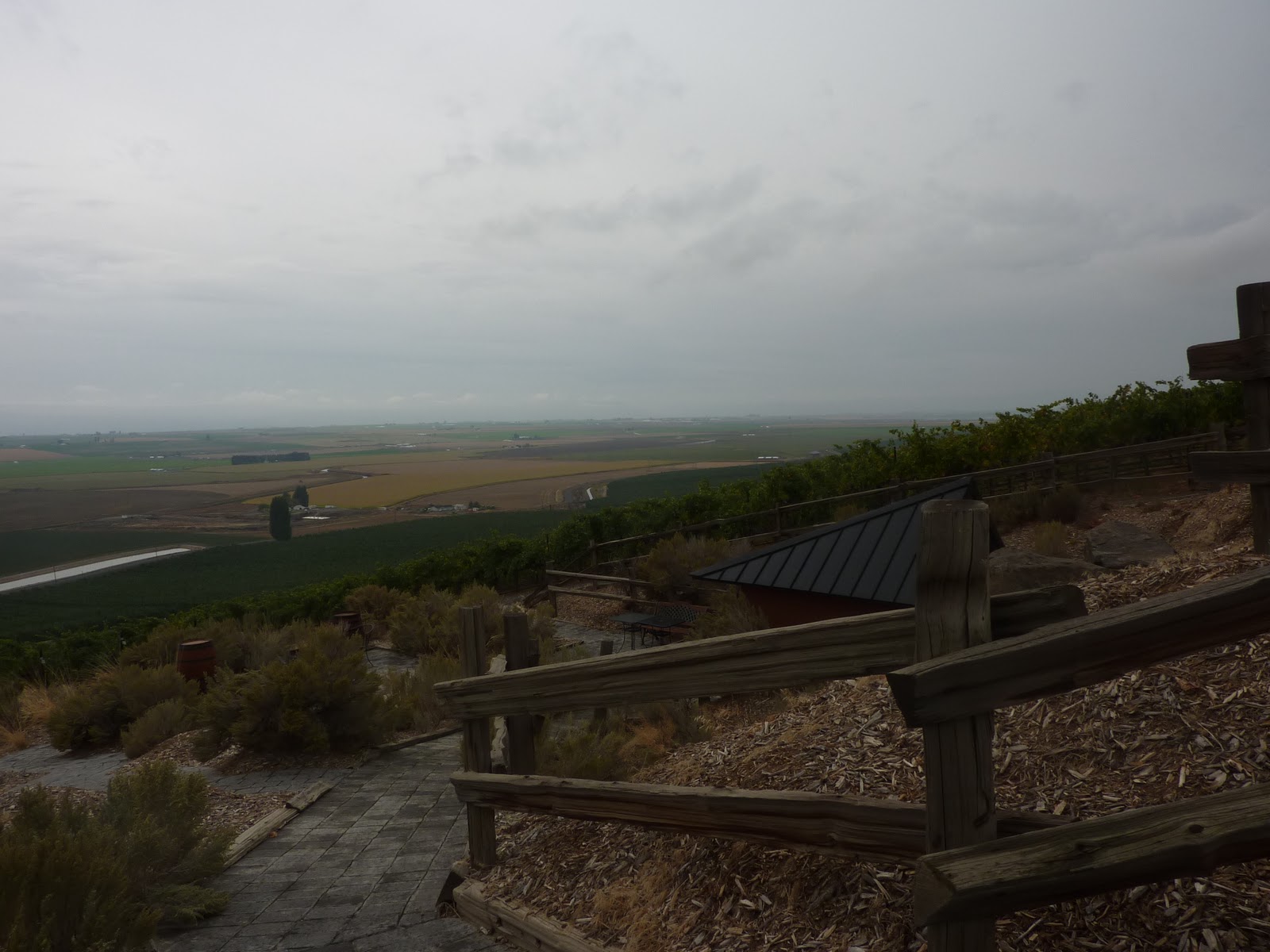


Boxes ready for filling. Champoux Vineyards

Tuesday, October 5, 2010
A True Hero: A Man Who Died in the Cause of Seeking Truth & Information
On 18 September 2010 I posted a link on Facebook about a story NPR ran about Witold Pilecki, a Polish Army Captain: "In September 1940, Pilecki didn't know exactly what was going on in Auschwitz, but he knew someone had to find out. He would spend two and a half years in the prison camp, smuggling out word of the methods of execution and interrogation. He would eventually escape and author the first intelligence report on the camp." He sent this information to Churchill and Roosevelt and the Polish Army in exile tried every means at its disposal to tell the world about the Holocaust. Take time to learn about this man.
Monday, October 4, 2010
The Roma, again
PRI's The World reported on efforts to reintegrate the Roma into Bulgarian society. This link should get to an audio of the report. The question remains/arises: what is it about Europe (east or west) or elsewhere that the Roma create this tension and inability for one group to be accepted by another. This situation has been intractable for over 1000 years. A second Wikipedia link has some interesting information on the arrival of Roma people in North America in the early 19th century.
Subscribe to:
Posts (Atom)
For the full article, click on the linked headline above.